Insights into Statistical Relational Learning: Models, Methods, and Applications
This overview explores probabilistic logical approaches to learning from relational data, contrasting model-based methods (e.g., Bayesian Networks, Probabilistic Logic Programs) with proof-based systems (e.g., Stochastic Context-Free Grammars). It addresses diverse learning settings: from interpretations, entailment, and traces. We emphasize concepts like inductive logic learning, refinement operators, background knowledge, and statistical learning principles including bias and likelihood. Key resources include workshops on statistical models and leading European Commission projects fostering advancements in this field.

Insights into Statistical Relational Learning: Models, Methods, and Applications
E N D
Presentation Transcript
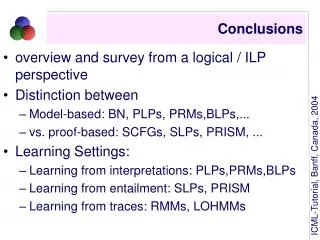
Conclusions • overview and survey from a logical / ILP perspective • Distinction between • Model-based: BN, PLPs, PRMs,BLPs,... • vs. proof-based: SCFGs, SLPs, PRISM, ... • Learning Settings: • Learning from interpretations: PLPs,PRMs,BLPs • Learning from entailment: SLPs, PRISM • Learning from traces: RMMs, LOHMMs
Conclusions - continued • Learning includes principles from • Inductive logic learning / multi-relational data mining • Refinement operators • Background knowledge • Bias • Statistical learning • Likelihood • Independencies • Priors
Thank you for your ... Sorry for all the probabilistic, logical stuff ! We hope that you have learned something !
Selected Links • Conferences, Workshops & Summer Schools • AAAI-2000 workshop on "Learning Statistical Models from Relational Data" (SRL-2000) • Summer School on Relational Data Mining 2002 • IJCAI-2003 workshop on "Learning Statistical Models from Relational Data" (SRL-2003) • ICML-2004 workshop on "Statistical Relational Learning and its Connections to Other Fields" (SRL-2004) • Forthcoming Dagstuhl seminar on "Probabilistic, Logical and Relational Learning - Towards a Synthesis" • Systems & Data • Probabilistic-Logical Model Repository • Projects • Evidence Extraction and Link Discouvery (EELD) DARPA Program • Efficient first-order probabilistic models for inference and learning, EPSRC research grant GR/N0739 • Application of Probabilistic Inductive Logic Programming (APRIL I) European Union Assessment Project IST-2001-33035 • Application of Probabilistic Inductive Logic Programming (APRIL II) Specific Targeted Research Project" funded by the European Commission under the "Sixth Framework Programme (2002-2006); Information Society Technologies" "Future and Emerging Technologies" arm. Contract no. FP6-508861