Download
1 / 10
100 likes | 216 Views
This document presents a comprehensive overview of stereo vision configuration and accuracy as applied to the Hauraki Gulf. It details the optical axes meeting at a fixation point, the configuration of common fields of view (CFoV), and the relationships between the imaging of scene objects and their depth accuracy. Key concepts include the angular field of view, baseline calculations, and determination of optimal object locations based on disparity and depth resolution. Understanding these fundamentals enhances the effectiveness of stereo vision systems in diverse applications.

E N D
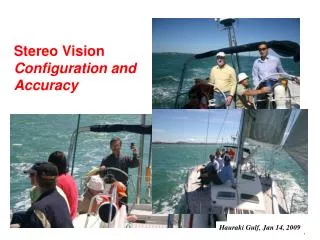
Stereo VisionConfiguration andAccuracy Hauraki Gulf, Jan 14, 2009
General Configuration • Optical axes • Meet at fixation point, P • Have angle between them • CFoV has arbitrary shape
Canonical Configuration Scene object FoV (single camera) Closest point of CFoV (Half)Angular FoV Optical centres Image of scene object Baseline
Field of view – Verging axis FoV (single camera) Scene object (Half)Angular FoV Optical centre
Common Field of View – Verging axes Fixationpoint Limit of CFoV = 0 > 2 = 2 (Canonical config)
Veith-Muller Circle Figure 5
Object placement Object of extent, a z > Zmin and z < Zamax Object of extent, a z > Zmin -2 < < 2 2 < <
Depth AccuracyCanonical configuration Points at intersections imaged onto centres of pixels in L and R images
Optimal object location Depth resolution vs distance Optimum baseline, b a
Canonical Configuration • Disparity, • Extent of CFoV • Depth resolution • vs z