Cluster Workshop 2010-05-20
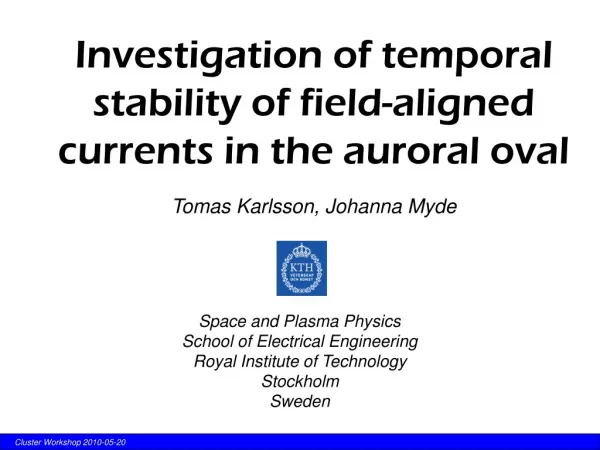
This workshop presentation discusses the temporal stability of field-aligned currents (FACs) observed in the auroral oval, focusing on data analysis from the Cluster mission. Key findings include the characteristic lifetime of FACs around 9 minutes, which aligns with previous studies. Cross-correlation methods are employed to study temporal variations, and the investigation highlights dependencies on magnetic latitude and local time. Future research directions include enhanced normalization techniques and spectral analysis for better understanding the dynamics of electric fields and Poynting flux in the auroral region.

Cluster Workshop 2010-05-20
E N D
Presentation Transcript
Cluster Workshop 2010-05-20 Space and Plasma PhysicsSchool of Electrical EngineeringRoyal Institute of TechnologyStockholmSweden Investigation of temporal stability of field-aligned currents in the auroral ovalTomas Karlsson, Johanna Myde
Cluster Workshop 2010-05-20 Introduction Boudouridis and Spence, 2007 DMSP particle data Le, Wang, Slavin, and Strangeway, 2007 Space Technology 5, magnetic field data tLS = 10 mintMS = 1 min
Cluster Workshop 2010-05-20 Magnetic field data from auroral oval passage East j DB ILAT(S/C 1)=80 ILAT(S/C 1)=65 DBEAST (nT) 3200 s t (s)
Cluster Workshop 2010-05-20 Cross correlation lag S/C 1 ILAT=65 80 S/C 2 ILAT=65 80 t cross-covariance lag auto-covariances (for L=0)
Cluster Workshop 2010-05-20 Magnetic field data from auroral oval passage ILAT(S/C 1)=80 ILAT(S/C 1)=65 DBEAST (nT) t (s)
Cluster Workshop 2010-05-20 Cross correlation 14 12 13 Cross correlation coefficient 23 24 34 lag (s)
Cluster Workshop 2010-05-20 Raw correlations 2002-20097938 correlations, 1323 oval crossings day night Cross correlation coefficient lag (s)
Cluster Workshop 2010-05-20 Correlations, full oval, 2002-2009 Cross correlation coefficient lag (s)
Cluster Workshop 2010-05-20 Correlations, full oval, 2002-2009 Fit equation: Cross correlation coefficient C = 0.37C0 = 0.53t = 546 s lag (s)
Cluster Workshop 2010-05-20 Correlations, full oval, 2002-2009 Kp dependence 0 < Kp ≤ 11 < Kp ≤ 33 < Kp ≤ 9 Cross correlation coefficient lag (s)
Cluster Workshop 2010-05-20 Correlations, full oval, 2002-2009 MLT dependence EveningNight MorningDay (18-20)(22-00)(01-03)(11-13) Cross correlation coefficient lag (s)
S/C 1 ILAT=65 80 S/C 2 ILAT=65 80 S/C 2 ILAT=65 80 Cluster Workshop 2010-05-20 Sliding Cross Correlations pre-lag t winsize S/C 1 ILAT=65 80
1.0 cross correlation coefficient 0.5 0.0 Cluster Workshop 2010-05-20 Correlations 2002-2007, n=95 154 Window size = 3° ILAT lag (s)
Cluster Workshop 2010-05-20 Correlations, 2002-2007 Window size = 1° Window size = 3° ilat cross correlation coefficienrt lag (s)
Cluster Workshop 2010-05-20 Correlations, 2002-2007 Window size = 3° MLT lag (s)
Cluster Workshop 2010-05-20 Correlations, 2002-2007 Window size = 1° Window size = 3° MLT cross correlation coefficienrt lag (s)
Cluster Workshop 2010-05-20 Correlations, 2002-2007 Window size = 3° lag < 10 s 10 s < lag < 30 s cross correlation coefficienrt ilat 30 s < lag < 100 s 100 s < lag < 300 s MLT
Cluster Workshop 2010-05-20 Correlations, 2002-2007 Window size = 1° lag < 10 s 10 s < lag < 30 s cross correlation coefficienrt ilat 30 s < lag < 100 s 100 s < lag < 300 s MLT
Cluster Workshop 2010-05-20 Conclusions • Cross correlation method is a useful method for studying the temporal variations in the auroral oval, • FAC on the scale of the oval size have a characteristic life-time of around 9 min, consistent with Le et al. (10 min). • Meso-scale current life-time dependence on MLT and scale size: • Low-latitude currents somewhat more temporally stable than high-latitude currents.
Cluster Workshop 2010-05-20 Future work • Modify normalization in in cross correlation function • Study scale-size dependence with proper cross-spectral analysis (coherence function) • Study temporal characteristics of electric fields • Study energetic importance by calculating Poynting flux
Cluster Workshop 2010-05-20 Coherence function
1.0 cross correlation coefficient 0.5 0.0 Cluster Workshop 2010-05-20 Correlations 2002-2007, n=109 542 Window size = 1° ILAT lag (s)
Cluster Workshop 2010-05-20 Correlations, 2002-2007 Window size = 1° MLT lag (s)
Cluster Workshop 2010-05-20 This and that Smooth window in dB calculation: 400 s = 200 km