Microscopy
A microscope is a fundamental scientific tool that allows scientists to observe microscopic details not visible to the naked eye. From the early inventions by Hans and Zacharias Janssens in the 1590s to the improvements made by Robert Hooke and Anton van Leeuwenhoek in the 17th century, the microscope has evolved significantly. Modern light microscopes can achieve magnifications up to 2000X, while advanced types like scanning electron microscopes can reach up to 100 million times. Proper care and usage techniques are essential for effective microscopy.

Microscopy
E N D
Presentation Transcript
What is a microscope? • A scientific tool that helps scientists see things that cannot normally be seen with the “naked” eye.
History • Hans and Zacharias Janssens-1590s, Dutch Eyeglass Makers, Inventors • Early microscope was composed of a tube with lenses at both ends • Magnification ranged from 3X to 9X
History • Robert Hooke- 1635-1703, English Chemist, Mathematician, Physicist, and Inventor • Improved the compound light microscope and observed cork (bark of an oak tree) and coined the term cells. They resembled cells, which are rooms in monasteries.
History • Anton van Leeuwenhoek- 1632-1723, Wine Assayer, Surveyor, Cloth Merchant, Minor Public Official, and Inventor • Made the best one-lens microscope of his time. • He observed bacteria from teeth scrapings and protozoa from pond water. He called them “weebeasties” and “animalcules.”
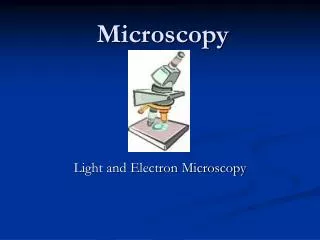
Compound Light Microscope Anatomy • Microscope • Resources available from sciencespot.net • Diagram of Light Microscope • Microscope Quiz • Microscope Crossword Puzzle
Proper Microscope Care and Technique • How do you carry a microscope? • Always begin focusing on which objective? • Only use the fine adjustment knob for which objective? • How do you properly store a microscope?
Using a Microscope in Lab • Always make sure the stage is all the way up when focusing and slowly bring the stage down. • When on low power, use the course adjustment knob (the big knob) • When on high power, use the fine adjustment knob (the little knob) • NEVER use the course adjustment knob on high power!!! Why? STOP
Other Notes… • Center the object in the field of view NO! YES!
Other Notes… • Microscopes are parfocal- you can focus on scanning objective and switch to low-power and high-power objectives with minor adjustments in focusing • At higher magnification, less light appears to pass through a specimen • Wet mounts are temporary
Other Notes… • Modern light microscopes are limited to 2000X due to lens optics • Or higher powers of magnification, different types of microscopes are needed- they DO NOT USE LIGHT
Effect of Changing Objectives from Scanning to Low to High Power
Types of Microscopes Follow the following link: http://www.cas.muohio.edu/mbi-ws/microscopes/types.html
Stereoscope/Dissecting Microscope • Used in dissections • Images are NOT inverted
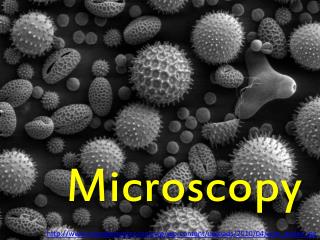
Scanning Electron MicroscopeSEM • Sweeps a beam of electrons over the surface of a specimen • Approx. 60,000X magnification (max.) • Example
Transmission Electron Microscope (TEM) • Aims a beam of electrons through a specimen • Magnifies +100,000X
Scanning Tunneling Microscope/Probe (STM) • Electrons flow from the tip of the probe and the surface of the specimen • Magnifies up to 100 million times (100,000,000X) • Can see the surface of atoms!