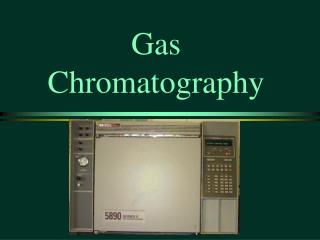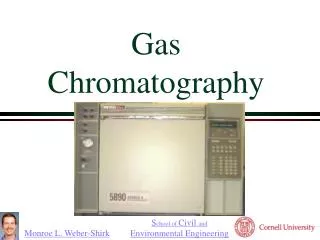
Gas Chromatography
280 likes | 411 Views
Gas-liquid chromatography is a technique based on the partitioning of analytes between a gaseous mobile phase and a liquid stationary phase on an inert solid surface. Initially developed by Martin and Synge in 1941, this method involves vaporizing samples and injecting them into a chromatographic column, where the separation occurs due to the flow of an inert gas. Gas chromatography is widely employed across various scientific fields, providing essential insights in areas such as chemistry, pharmaceuticals, and environmental analysis.


Gas Chromatography
E N D
Presentation Transcript
Gas Chromatography By Naaimat Muhammed
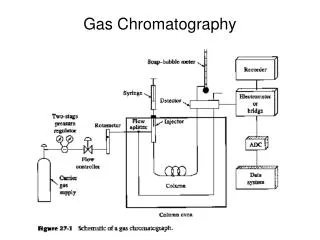
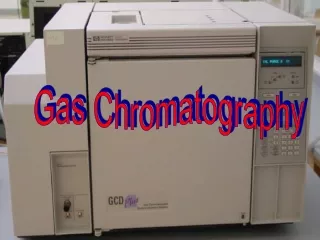
Gas- liquid chromatography is based upon the partition of the analyte between a gaseous mobile phase and a liquid phase immobilized on the surface of an inert solid. • The concept of gas-liquid was first enunciated in 1941 by Martin and Synge, who were also responsible for the development of liquid-liquid partition chromatography . • In gas chromatography, the sample is vaporized and injected onto the head of a chromatographic column • Elution is brought about by the flow of an inert gaseous mobile phase. • Gas-liquid chromatography finds widespread use in all fields of science, where its name despite the fact that this usage neglects gas solid chromatography as a legitimate kind of chromatography
Reference: • http://ull.chemistry.uakron.edu/analytical/GC/ • Principles of Instrumental Analysis, Sloog, Holler, Nieman, Saunders College Pub 5th Edition (1998)