RFLP and PCR Techniques in Genetics
160 likes | 294 Views
Explore RFLP and PCR techniques, Southern Blotting, and differences from DNA replication. Learn how to visualize DNA segments and amplify specific DNA regions.


RFLP and PCR Techniques in Genetics
E N D
Presentation Transcript
Genetics Techniques: RFLP & PCR AP Biology Unit 3
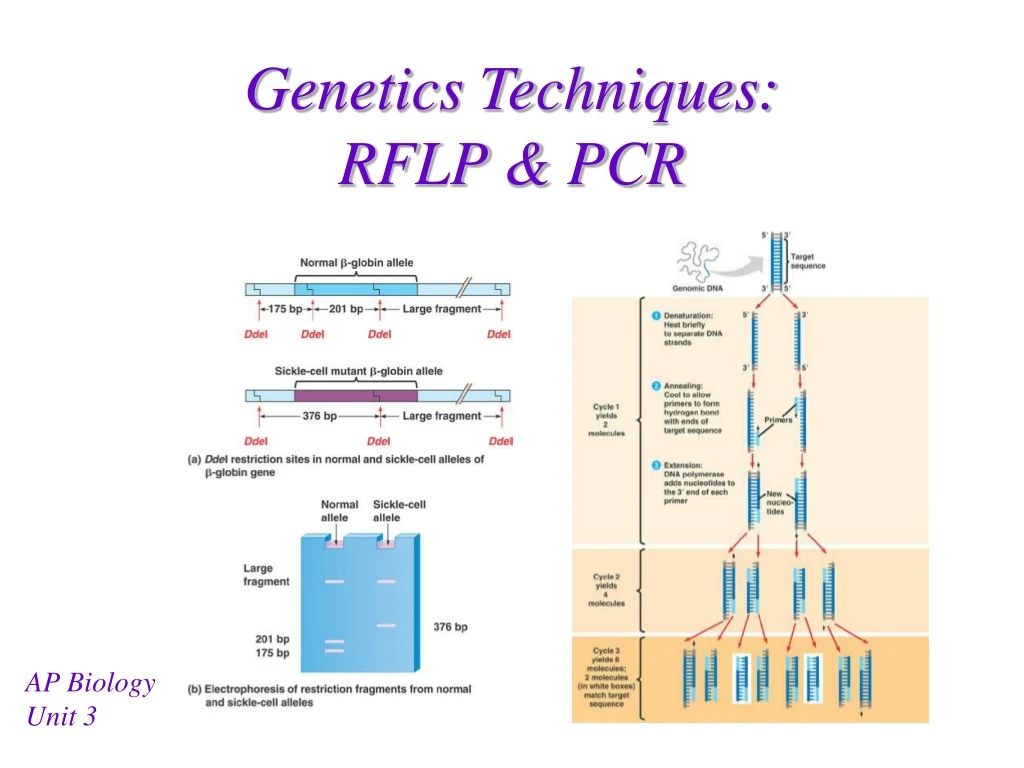
RFLP How many fragments will result when each of these alleles are digested with DdeI? • Stands for Restriction Fragment Length Polymorphism • Takes advantage of differences in DNA between individuals that result in different fragments when digested with restriction enzymes 3 fragments 2 fragments
RFLP • To see RFLP, DNA is digested with the appropriate restriction enzymes and run on an agarose gel. • A Southern Blot is performed to complete the analysis.
Southern Blotting • A method to visualize specific segments of DNA– usually a particular gene. • Uses radioactive probes that bind to the specific DNA segments • Ex. When testing for the hemoglobin alleles, the probe would bind to these regions
Southern Blotting • Steps: • Soak gel in basic solution to separate DNA strands • Transfer DNA on to a nylon membrane (spacing of DNA is maintained) • Incubate with radioactive probe for specific segment • Wash away unbound probe • Detect probes using x-ray film autoradiograph
RFLP Animations • Animation #1 • Animation #2
Polymerase Chain Reaction • PCR allows scientists to amplify small, specific segments of DNA = make millions of copies of segment • Allows for amplification at an exponential rate • DNA Replication in a test tube
Materials needed for PCR • Target DNA (the DNA you want to copy) • Free Nucleotides (A, T, C, G) • Primers (DNA primers, not RNA) • Taq Polymerase (heat stable DNA Polymerase III) • Mg2+ (cofactor that DNA Polymerase III needs to work) • Buffer • Thermocycler (machine that changes temperatures)
Overview of PCR • Uses different temperatures to amplify DNA • Step 1: Separate existing DNA strands – 95ºC (Denaturation) • Step 2: Lower temperature to allow primers to bind to target DNA – 55ºC (Annealing) • Step 3: Raise temperature to allow Taq Polymerase to build DNA strand – 72ºC (Extension)
Differences between DNA Replication & PCR • No Helicase or Topoisomerase – PCR uses the first heat step to completely separate the strands of DNA • No Primase – primers are already made • DNA primers (not RNA) – no need for DNA Polymerase I • No leading or lagging strands – DNA is completely unzipped, no Okazaki fragments
PCR animation • animation