Download
1 / 15
150 likes | 280 Views
This lecture explores the intertwining of historical and sociological sensibilities, focusing on how social, political, and cultural factors influence scientific development and understanding. It delves into the scientific revolution, the paradigm shifts articulated by Thomas Kuhn, and the intricate ties between science and society. The evolution of science in the 20th century, including its institutionalization and professionalization, is also examined. By analyzing the dynamics of scientific beliefs and controversies, the lecture positions science within a broader social context, encouraging a critical re-evaluation of its role in modern society.

E N D
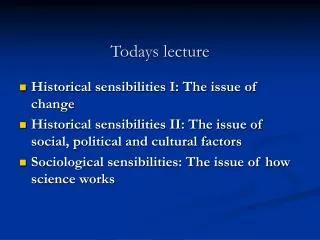
Todays lecture • Historical sensibilities I: The issue of change • Historical sensibilities II: The issue of social, political and cultural factors • Sociological sensibilities: The issue of how science works
History of science and ideas • Founded in 1936 • Presented as an answer to the problem of the two cultures in the 1950s and 1960s • Today oriented towards new questions of how to understand science on different levelss
Historical sensibilities I: The issue of change • The scientific revolution: - Coherent event in the 17th century - Mechanization of the universe - Challenge against aristotelian philosophy - Optimism of the possibilities of obtaining knowledge - Modern empiricism, ideas about scientific methods
Historical sensibilities I:The issue of change • Thomas Kuhn - Normal science in paradigms - Anomalies occur, constitutes a crisis for the paradigm - A scientific revolution has occured - Different paradigms are incommensurable, cannot communicate
Historical sensibilities II – social, political, cultural and organisational factors
Historical sensibilities II:Twentieth century genetics • The political roots of science • The importance of organisational forms – big science means certain questions • The importance of predictions of future science – takes on cultural forms.
Historical sensibilities II: Science and society • Natural sciences gained more resources during the 20th century • Allocation of resources from national, political and economic resources • Science under governmental planning: science could produce technological progress • A new class of professional experts • Science became visible in the cultural debate
Historical sensibilities II:Some institutional aspects • The bonds between science and society got stronger • Scientific professionals replaced amateurs • Professional associations, journals, meetings, standardized education • New disciplines: geology, biology, physiology • A rapid industrialisation and urbanisation • Modern national states • A national science policy in the 1930s
Historical sensibilities II: Science and society - summary • Society gained influence over science and science gained influence over society • The overarching argument was that science was a productive force • Scientific institutionalisation was a product of the modern national states
Sociological sensibilities: The issue of how science works
Common roots and features in Science and Technology Studies • The protest movements of the 1960s • Constructivism • Critique of linear models and of technological determinism
The flaws of technological determinism ¤ A bad model for historic change: disregards a lot of important things. ¤ Isolates technology from human actions ¤ Misrepresents the relationship between science and technology ¤ Misrepresents the relationship between technology and industry
General themes in Science and Technology Studies • Critical view of what is being studied • Assumes a position outside of science and sees it as an activity among others • Denies the isolation of science and technology from each other – speaks of a seamless web • Guided by a willingness to place science and technology in a broader social and historical context
Sociology of science • Social processes explain phenomena • Why social groups hold scientific beliefs • Studies controversies • Does not study psychological processes, genious or ”right” or ”wrong”
The Golem • Discusses how normal science evolves through uncertainties and controversies • Sociological in scope: human action, interaction and negotiations • Messiness of experiments – experimenters regress • Controversies die away quietly