Joint Density Function
The joint density function, denoted as fX,Y(x, y), describes the probability density at any point (x, y) for two random variables, X and Y. This function illustrates how the two variables interact over a unit area. Furthermore, for two random variables to be considered independent, their joint density must equal the product of their individual marginal densities. Understanding these concepts is crucial in probability theory and statistics as they form the backbone for analyzing the relationship between multiple random variables.

Joint Density Function
E N D
Presentation Transcript
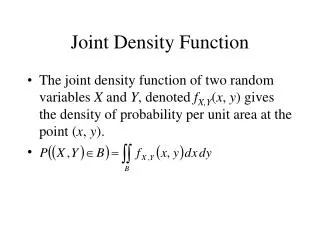
Joint Density Function • The joint density function of two random variables X and Y, denoted fX,Y(x, y) gives the density of probability per unit area at the point (x, y).
Joint Density for Independent RVs • Random variables X and Y are independent if and only if the joint density of X and Y is the product of the two marginal densities: