Ores
Ores. Principally we discuss ores as sources of metals However, there are many other resources bound in minerals which we find useful How many can we think of?. http://eps.berkeley.edu/courses/eps50/documents/lecture31.mineralresources.pdf. Ore Deposits.

Ores
E N D
Presentation Transcript
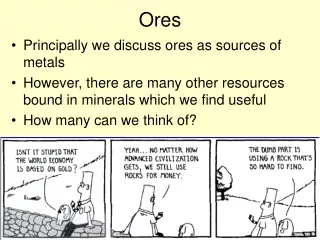
Ores • Principally we discuss ores as sources of metals • However, there are many other resources bound in minerals which we find useful • How many can we think of?
http://eps.berkeley.edu/courses/eps50/documents/lecture31.mineralresources.pdfhttp://eps.berkeley.edu/courses/eps50/documents/lecture31.mineralresources.pdf
Ore Deposits • A deposit contains an unusually high concentration of particular element(s) • This means the element(s) have been concentrated in a particular area due to some process • What sort of processes might concentrate these elements in one place?
Gold Au • Distribution of Au in the crust = 3.1 ppb by weight 3.1 units gold / 1,000,000,000 units of total crust = 0.00000031% Au • Concentration of Au needed to be economically viable as a deposit = few g/t 3 g / 1000kg = 3g/ 1,000,000 g = 0.00031% Au • Need to concentrate Au at least 1000-fold to be a viable deposit • Rare mines can be up to a few percent gold (extremely high grade)!
Ore minerals • Minerals with economic value are ore minerals • Minerals often associated with ore minerals but which do not have economic value are gangue minerals • Key to economic deposits are geochemical traps metals are transported and precipitated in a very concentrated fashion • Gold is almost 1,000,000 times less abundant than is iron
Economic Geology • Understanding of how metalliferous minerals become concentrated key to ore deposits… • Getting them out at a profit determines where/when they come out
http://eps.berkeley.edu/courses/eps50/documents/lecture31.mineralresources.pdfhttp://eps.berkeley.edu/courses/eps50/documents/lecture31.mineralresources.pdf
Black smoker metal precipitation http://oceanexplorer.noaa.gov/explorations/02fire/background/hirez/chemistry-hires.jpg
Ore deposit environments • Magmatic • Cumulate deposits – fractional crystallization processes can concentrate metals (Cr, Fe, Pt) • Pegmatites – late staged crystallization forms pegmatites and many residual elements are concentrated (Li, Ce, Be, Sn, and U) • Hydrothermal • Magmatic fluid - directly associated with magma • Porphyries - Hot water heated by pluton • Skarn – hot water associated with contact metamorphisms • Exhalatives – hot water flowing to surface • Epigenetic – hot water not directly associated with pluton
Ore deposit environments • Sedimentary • Placer – weathering of primary minerals and transport by streams (Gold, diamonds, other) • Banded Iron Formations – 90%+ of world’s iron tied up in these • Evaporite deposits – minerals like gypsum, halite deposited this way • Laterites – leaching of rock leaves residual materials behind (Al, Ni, Fe) • Supergene – reworking of primary ore deposits remobilizes metals (often over short distances)
Geochemical Traps • Similar to chemical sedimentary rocks – must leach material into fluid, transport and deposit ions as minerals… • pH, redox, T changes and mixing of different fluids results in ore mineralization • Cause metals to go from soluble to insoluble • Sulfides (reduced form of S) strongly binds metals many important metal ore minerals are sulfides! • Oxides – Oxidizing environments form (hydroxy)oxide minerals, very insoluble metal concentrations (especially Fe, Mn, Al)
Hydrothermal Ore Deposits • Thermal gradients induce convection of water – leaching, redox rxns, and cooling create economic mineralization
Massive sulfide deposits • Hot, briny, water leaches metals from basaltic ocean rocks • Comes in contact with cool ocean water • Sulfides precipitate
Vermont Copperbelt • Besshi-type massive sulfide deposits • Key Units: • Giles Mountain formation – More siliciclastic, including graphitic pelite, quartoze granofels (metamorphosed greywacke), hornblende schist, amphibolite • Standing Pond Volcanics – mostly a fine grained hormblende-plagioclase amphibolite, likely formed from extrusive basaltic rocks (local evidence of pillow structures in St. Johnsbury). Felsic dike near Springfiled VT yielded a U-Pb age of 423± 4 Ma. • Waits River formation – Calcareous pelite (metamorphosed mudstone), metalimestone, metadolostone, quartzite.