Download
1 / 3
0 likes | 1 Views
Solar energy has now become a popular option being installed in residences and commercial spaces alike as it saves costs and proves to be a much sustainable solution as compared to traditional systems. Based on the same technology, solar heat pumps are also making their way into homes and offices. By combining solar energy with advanced heat pump technology, these systems capture heat from the surrounding environment, converting it into water and space heating opportunities. Letu2019s walk into the concept of how these systems work, the science behind them, and why theyu2019re becoming increasingly po

E N D
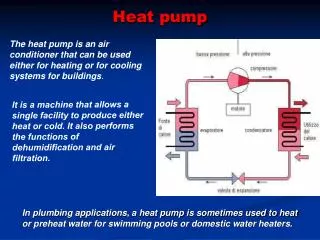
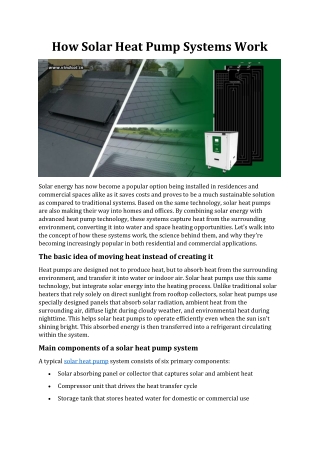
How Solar Heat Pump Systems Work Solar energy has now become a popular option being installed in residences and commercial spaces alike as it saves costs and proves to be a much sustainable solution as compared to traditional systems. Based on the same technology, solar heat pumps are also making their way into homes and offices. By combining solar energy with advanced heat pump technology, these systems capture heat from the surrounding environment, converting it into water and space heating opportunities. Let’s walk into the concept of how these systems work, the science behind them, and why they’re becoming increasingly popular in both residential and commercial applications. The basic idea of moving heat instead of creating it Heat pumps are designed not to produce heat, but to absorb heat from the surrounding environment, and transfer it into water or indoor air. Solar heat pumps use this same technology, but integrate solar energy into the heating process. Unlike traditional solar heaters that rely solely on direct sunlight from rooftop collectors, solar heat pumps use specially designed panels that absorb solar radiation, ambient heat from the surrounding air, diffuse light during cloudy weather, and environmental heat during nighttime. This helps solar heat pumps to operate efficiently even when the sun isn’t shining bright. This absorbed energy is then transferred into a refrigerant circulating within the system. Main components of a solar heat pump system A typical solar heat pump system consists of six primary components: •Solar absorbing panel or collector that captures solar and ambient heat •Compressor unit that drives the heat transfer cycle •Storage tank that stores heated water for domestic or commercial use
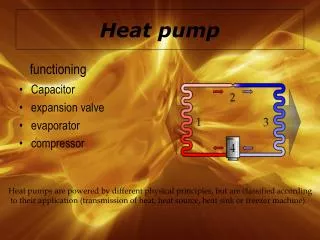
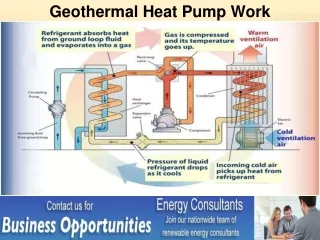
•Heat exchanger that transfers heat from the refrigerant to the water or air •Controller system that monitors temperature and manages operation for optimal efficiency •Backup heating element that provides additional support during extremely high demand. In many modern designs, these components are integrated into compact, all-in-one units that simplify installation and reduce space requirements. The science behind the heat pump cycle Step 1: Heat absorption The refrigerant inside the solar collector or panel absorbs heat from solar radiation and ambient air. This refrigerant evaporates at low temperatures, meaning that it turns into gas even when exposed to mild heat. Step 2: Compression The gaseous refrigerant moves into the compressor, where the pressure of the gas increases, and the temperature rises as well. As a result, the refrigerant becomes a high- temperature and high-pressure gas. Step 3: Heat transfer The high-pressure hot gas flows into the condenser, where it transfers its heat into a water storage tank for water system, or an air distribution system for space heating. As the heat is released, the refrigerant cools down and turns back into liquid form. Step 4: Expansion and reset The liquid refrigerant then passes through an expansion valve, reducing its temperature and pressure. It then returns to the solar panel or evaporator to repeat the cycle. This loop allows the system to deliver consistent heating using minimal electricity. Why it uses so little electricity One of the biggest advantages of solar heat pumps is their exceptional efficiency compared to conventional heating methods. Instead of producing heat by consuming large amounts of electricity, the system transfers existing heat from the surrounding environment into usable hot water or indoor heating. This fundamental difference significantly reduces energy consumption. The integration of solar energy further boosts performance by allowing the system to absorb additional heat from sunlight and ambient air. As a result, the compressor operates with less strain, improving overall efficiency, lowering electricity usage, and extending the system’s lifespan while maintaining consistent heating performance throughout the year. Year-round operation One common issue buyers are always worried about is whether or not the heat pump will work across all seasons. Now that we have learnt how these heat pumps do not
need direct sunlight to work, and can work even during nighttime and cloudy days, it clearly shows how they can work in all climatic conditions – summers, winters, and monsoons. The systems absorb heat from ambient air temperatures, environmental heat retained in the atmosphere, and diffuse solar radiation on cloudy days. Even at night, the surrounding air contains thermal energy. As long as the temperature is above absolute zero, there is heat available to extract. Modern systems are engineered to operate efficiently across a wide temperature range, making them suitable for diverse climatic conditions. Applications of solar heat pump systems Solar heat pumps are highly versatile and suitable for both residential and commercial applications. In homes, they are commonly used for bathroom and kitchen water heating, as well as space heating to maintain comfortable indoor temperatures. Their ability to deliver consistent hot water makes them ideal for daily household needs. In commercial environments, these systems are widely used in hotels, resorts, hospitals, hostels, and industrial facilities that require continuous hot water and heating throughout the day. Since the technology is scalable, multiple units can be interconnected to meet higher capacity demands efficiently and reliably. Leading manufacturers like Vindsol offer advanced solar heat pump systems designed to cater to both domestic and large-scale commercial requirements, ensuring dependable performance, energy efficiency, and long-term durability. Solar heat pumps represent a powerful evolution in water and space heating technology. By intelligently combining solar energy with heat transfer science, they deliver consistent heating performance, while using minimal electricity. Instead of generating heat through energy-intensive methods, they harness the heat already present in the environment, and amplify it for practical use. For beginners exploring energy-efficient heating solutions, understanding how these systems work reveals why they are increasingly considered one of the most reliable, eco-friendly, and cost- effective heating options available today. As energy requirements grow and sustainability becomes non-negotiable, solar heat pumps are shaping the future of heating technology. Read More Article : How Solar Heat Pump Systems Work