Download
1 / 4
0 likes | 0 Views
Nexim Alloys is best performing manufacturers, stockists, supplier & exporter of Copper Flex Bars. These Bars are manufactured in different size, dimension & thickness and are delivered to customer as per their need & requirement. These Copper Flex Bars are sold to customers at affordable prices.

E N D
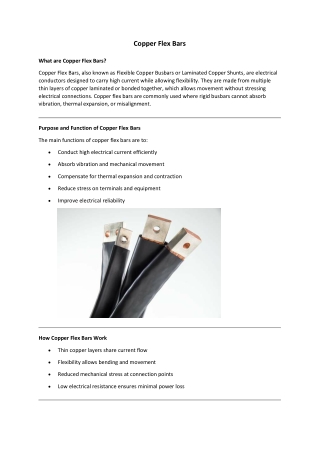
Copper Flex Bars What are Copper Flex Bars? Copper Flex Bars, also known as Flexible Copper Busbars or Laminated Copper Shunts, are electrical conductors designed to carry high current while allowing flexibility. They are made from multiple thin layers of copper laminated or bonded together, which allows movement without stressing electrical connections. Copper flex bars are commonly used where rigid busbars cannot absorb vibration, thermal expansion, or misalignment. Purpose and Function of Copper Flex Bars The main functions of copper flex bars are to: • Conduct high electrical current efficiently • Absorb vibration and mechanical movement • Compensate for thermal expansion and contraction • Reduce stress on terminals and equipment • Improve electrical reliability How Copper Flex Bars Work • Thin copper layers share current flow • Flexibility allows bending and movement • Reduced mechanical stress at connection points • Low electrical resistance ensures minimal power loss
Key Characteristics of Copper Flex Bars • High electrical conductivity • Excellent flexibility • Low resistance and heat generation • High fatigue resistance • Compact and lightweight design • Long service life Materials Used in Copper Flex Bars Copper Grades: • Electrolytic Tough Pitch (ETP) Copper – C11000 • Oxygen Free Copper (OFC) • Electrolytic Grade Copper Insulation (Optional): • PVC • Heat-shrink tubing • Epoxy coating • Polyester or silicone insulation Types of Copper Flex Bars 1. Laminated Copper Flex Bars • Multiple copper foils stacked and bonded • Most commonly used type 2. Braided Copper Flex Bars • Made from woven copper strands • High flexibility, lower current density 3. Insulated Copper Flex Bars • Covered with insulation for safety • Used in compact electrical systems
4. Custom-Shaped Flex Bars • Designed to specific bends and hole patterns • Used in tight installation spaces Manufacturing Process 1.Selection of high-purity copper 2.Cutting copper foils to required dimensions 3.Stacking and alignment 4.Bonding or welding ends 5.Punching or drilling terminals 6.Surface treatment (tin, silver, or nickel plating) 7.Insulation (if required) 8.Electrical and mechanical testing Design Parameters Important design considerations include: • Current rating (Amps) • Voltage level • Number of copper layers • Thickness and width • Length and bend radius • Terminal hole size and spacing • Operating temperature • Environmental conditions Advantages of Copper Flex Bars • Reduces mechanical stress on equipment • Handles high current loads • Improves system reliability • Easier installation than rigid busbars • Longer service life
Limitations of Copper Flex Bars • Higher cost compared to rigid busbars • Limited structural strength • Requires proper termination design • Not suitable as a load-bearing component Applications of Copper Flex Bars • Electrical panels and switchgear • Transformers • Power distribution units • Battery energy storage systems • Electric vehicles (EVs) • UPS systems • Renewable energy systems • Industrial machinery Why Choose Copper Flex Bars? Copper flex bars are the right choice when: • High current transfer is required • Vibration or movement is present • Compact and reliable connections are needed • Equipment life must be extended For More Details https://www.neximalloys.com/copper-flex-bars-manufacturers-exporters-suppliers-stockists.html Contact US: +91- 8082302533 If any enquiries please contact us our support team will connect you as soon as possible