Download
1 / 10
0 likes | 0 Views
Explore how BIM meets the Metaverse to deliver immersive visualization for AEC teams improving design reviews, collaboration, and decision-making.

E N D
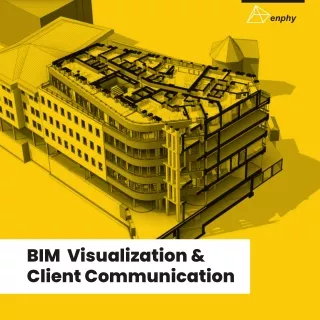
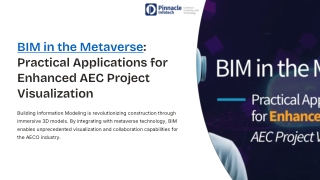
BIM in the Metaverse: Practical Applications for Enhanced AEC Project Visualization Building Information Modeling is revolutionizing construction through immersive 3D models. By integrating with metaverse technology, BIM enables unprecedented visualization and collaboration capabilities for the AECO industry.
INDUSTRY EVOLUTION BIM and Metaverse Together BIM's integration with metaverse technology creates next-level visualization possibilities. Project teams can virtually walk through building prototypes and collaboratively make design decisions in shared environments. This alliance addresses execution-level challenges and redefines industry standards, enabling real-time project administration, production simulation, and data analytics for optimized operational efficiency.
Key Practical Applications Enhanced Visualization Collaborative Decision-Making Stakeholder Engagement Immersive 3D modelling spaces with dynamic dashboards, color-coded overlays, and temporal simulations showing project progress. User-friendly interfaces allow non-technical stakeholders to explore virtual spaces and understand design rationales. Teams from different locations work synchronously, simulating scenarios and evaluating outcomes in real-time.
Safety Planning and Construction Logistics Unlike static 2D plans, metaverse-enabled workflows allow virtual construction sequencing. Teams can simulate equipment paths, visualize scaffold staging, and identify potential hazards before they occur. Safety officers can accurately identify hazard zones, practice emergency responses, and understand logistics requirements based on spatial cues, reducing accidents and optimizing deliveries. Virtual Sequencing Hazard Identification Emergency Planning Risk Mitigation
REAL-WORLD INTEGRATION Design Validation and AI Integration Contextual Alignment AI-Powered Detection Predictive Analysis Integrate geospatial data to assess sunlight, wind paths, and surrounding infrastructure impact on projects. Automated issue detection identifies clashes and design inconsistencies through advanced algorithms. Simulate daylight distribution, energy consumption, thermal patterns, and occupant comfort metrics.
Case Study: Hospital Expansion Project Challenge: A major Arizona hospital needed to expand while maintaining operations, requiring coordination between construction teams, equipment vendors, clinicians, and facility managers. Solution: Stakeholders connected in a BIM-Metaverse environment to simulate patient flow, coordinate MEP systems, and rehearse installation sequences without worksite obstacles. Outcome: Improved design decisions, reduced disruptions, enhanced safety planning, and higher cost-efficiency.
Case Study: High-Rise Mixed-Use Development Challenge: A Texas mixed-use tower required close coordination between architecture, structural, and MEP systems aligned with interior design. Solution: Multidisciplinary teams navigated metaverse-simulated environments for clash-coordinated workflows. Clients explored spaces in real-time, and energy simulations optimized facade designs. Outcome: Coordinated workflows, smooth communication, minimized reworks, and reduced project costs.
Key Benefits of BIM in the Metaverse 1 2 3 4 Improved Understanding Faster Decisions Reduced Risk Enhanced Engagement Accelerated approvals through effective visualization and fluid information flows. Early detection and forecasting prevent costly reworks and fieldwork risks. AI, VR, and Digital Twins create meaningful, integrated experiences for all stakeholders. Immersive environments reduce misinterpretation through real-time shared visualization. 5 Lifecycle Continuity Digital twins enable facility management throughout operations and maintenance phases.
Implementation Considerations and Challenges Requirements Challenges • High-performance computing and graphics • Cloud storage and streaming bandwidth • AR/VR/MR hardware for immersive rendering • Data standardization frameworks • User training programs • Cybersecurity and access control • Cost and Scale: Hefty investments in hardware, software, and services • Learning Curve: Cultural transition to immersive technologies • Standardization Gaps: Non-compliance complicates data processing • Data Overload: Large volumes require clear normalization formats
The Future of Digital Construction BIM in the Metaverse is transforming how industry professionals visualize, collaborate, and execute projects. Moving beyond flat screens to immersive 3D environments, this technology enables cross-functional hubs with end-to-end AI support and extensive sustainability evaluation. The integration of BIM and the Metaverse will revolutionize the AEC industry, enabling smarter, more efficient processes that combine ideas and actions to achieve futuristic value in digital construction. Website URL : https://pinnacleinfotech.com/services/bim-facilities-management/ Email id : info@pinnacleinfotech.com