Download
1 / 8
0 likes | 2 Views
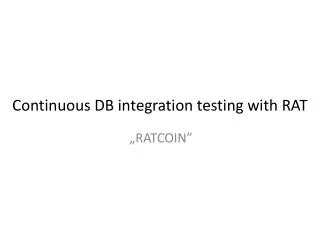
Onixu2019s Kingfisher is a powerful synthetic data platform that enables faster, safer continuous testing. Using advanced synthetic data generation tools, it creates realistic, compliant datasets without relying on production data. This synthetic data generator improves test coverage, supports CI/CD pipelines, and helps organizations release high-quality software with speed and confidence.

E N D
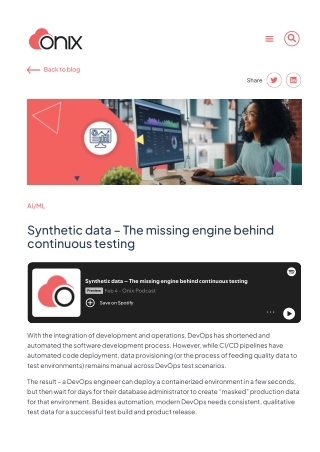
Back to blog Share AI/ML Synthetic data – The missing engine behind continuous testing Synthetic data – The missing engine behind continuous testing Preview Feb 4 · Onix Podcast Save on Spoti? With the integration of development and operations, DevOps has shortened and automated the software development process. However, while CI/CD pipelines have automated code deployment, data provisioning (or the process of feeding quality data to test environments) remains manual across DevOps test scenarios. The result – a DevOps engineer can deploy a containerized environment in a few seconds, but then wait for days for their database administrator to create “masked” production data for that environment. Besides automation, modern DevOps needs consistent, qualitative test data for a successful test build and product release.
In our previous blog, we discussed the relevance of synthetic data in continuous testing, and why application developers cannot depend on the availability of production data. In this blog, let’s explore more deeply why synthetic data is the “missing” engine that can power continuous testing in DevOps environments? What is synthetic data – and what it isn’t? De?ned, synthetic data is essentially arti?cial data that’s generated to mimic real-world data. This form of data is arti?cially generated using algorithms, rather than being collected from real-world events. In a DevOps environment, synthetic data serves as a suitable replacement for production data, while also ensuring compliance with data privacy regulations. Here’s what isn’t synthetic data: ?. Masked data Masked data is e?ectively an “altered” version of real data, while synthetic data is fully arti?cially generated. While masked data can still contain sensitive data in an obfuscated form, a synthetic data generator does not interact with real-world or production data, thus bypassing the sensitive parts. ?. Random data Random data often lacks any insightful correlations or context, making it ine?cient for testing purposes. On the other hand, synthetic data is not random, but “realistic’ data that’s arti?cially generated using AI algorithms. E?ectively, synthetic data mimics the statistical properties and relationships of real-world data. ?. Mock data Mock (or dummy) data lacks statistical value and does not re?ect the complexity of real-world data. Alternatively, synthetic data is smarter by replicating the statistical patterns of real-world data. Besides, mock data is manually generated using predetermined scripts (for example, random name generation), while synthetic data is automatically generated using AI models trained on real data. Once we understand what synthetic data is, and just as importantly, what it isn’t, the next question is how it behaves in real-world systems. Its true value shows up when it can be safely reused for continuous testing, without risk, across evolving testing needs. How synthetic data is designed to ?t continuous testing With inherent capabilities like referential integrity and business rule adherence, synthetic data is designed to ?t continuous testing in DevOps environments. Here’s how synthetic data maps to each of the following types of software testing: ?. Functional testing
To be e?ective, functional testing must ensure that the software product is aligned with speci?c functional requirements. This requires the real-time availability of high- quality data that replicates real-world scenarios. However, the use of production data is restricted by privacy laws and regulations. Synthetic data can ?ll this gap and replace production data used to test new functionalities. By adopting a shift-left approach, product functions can be tested much before they’re accessible to real users. ?. Regression testing As regression testing in DevOps is all about testing the impact of new features on existing functionalities, it requires a stable and reproducible ?ow of data that can be repeatedly used. Synthetic data can ful?l this requirement through a stable dataset that remains the same for every test run (as opposed to production data that keeps changing). Similarly, synthetic data in regression testing is useful for checking backward compatibility with old or legacy data. A synthetic data generation software can be used to programmatically generate deprecated data or legacy rules. ?. Performance or load testing This form of testing is reliant on the availability of high data volume and variety, which is challenging to ful?l using production data. Synthetic data is easier to multiply with datasets that are 10−100× larger than production datasets. Synthetic data generation tools can also generate a wide variety of data correlated to what’s more likely to happen in real-world situations. ?. Integration & API testing With integration & API testing, QA teams move from isolated applications to integrated systems, protocols, and connections. Synthetic data maintains cross- system referential integrity in modern DevOps environments. This can prevent the failure of integration testing, which is common with manual or masked data. With synthetic data, API testing can unlock parallel development that allows both API development teams to work simultaneously on either half of the integration. ?. Security testing A secure synthetic data platform enables cybersecurity teams to “simulate” high- risk scenarios without risking the leak of real, sensitive data. Synthetic data generators can hit any application with malformed data to test for any memory leaks or crashes. Synthetic data is also useful to test compliance with privacy laws and for data leakages. Additionally, it can be used for applications like threat modelling and fraud detection.
Here’s why synthetic data is a “perfect” complement to continuous testing frameworks: Zero-wait data provisioning: As compared to real-world production data that requires approvals, synthetic data is available on demand and can be used anytime for CT frameworks. This accelerates testing by 50 to 80%. Shift–left enablement: With synthetic data, QA teams can begin early testing as they no longer need to wait for the availability of production data. Edge case test coverage: Real-world data doesn’t provide test coverage for edge cases (or rare) scenarios, such as ?nancial fraud. Using synthetic data, ?rms can now “simulate” such scenarios and test their systems for resilience. Regulatory compliance: Unlike real-world sensitive data, CT frameworks can use synthetic data to remain compliant with regulations like GDPR and HIPAA. It ensures that no sensitive data enters the testing environment. Bene?ts of synthetic data in continuous testing Software companies can leverage a host of bene?ts by using synthetic data in their continuous testing process. As an example, with the traditional approach, QA teams have to wait for days or weeks for a “fresh” allocation of production data. A synthetic data generator can improve data availability by 70−80% by generating arti?cial data using AI models or scripts. As mentioned before, synthetic data also improves test coverage by including rare-world edge cases, thus leading to improved defect discovery and high-quality products. Besides these bene?ts, companies can also bene?t from scaling up continuous testing to the next level and delivering optimum security and resilience testing outcomes. However, realizing these bene?ts at scale requires more than just generating data, it demands careful design, governance, and control to avoid new risks from emerging. Common challenges with synthetic data – and how to address them While synthetic data is bene?cial for continuous testing, it also has its share of common challenges. Here are some of these challenges and how they can be addressed by a modern synthetic data platform: ?. Data realism Among the common challenges, synthetic data may not provide su?cient realism and complexity as compared to real-world data. A modern platform can overcome this problem by including critical edge cases and real-world outliers.
?. Referential integrity When tested with synthetic data, data-driven applications can fail or crash due to a lack of referential integrity across many database tables.With AI-enabled schema mapping, modern platforms can automatically “crawl” any database schema and identify parent-child relationships. ?. Scalability and performance Depending on their requirements, enterprises often require massive volumes of synthetic data for load and performance testing. Synthetic datasets for testing purposes can escalate data storage and computing costs. Cloud-powered platforms can improve scalability and the availability of computational resources for massive data generation. ?. Outdated data As real-world conditions change, synthetic data can become outdated and irrelevant for enterprises, thus leading to system collapses when tested on previous data used. Besides, data drift is a common challenge for synthetic datasets that don’t evolve with changing business conditions. Modern platforms can help by monitoring production data and making regular updates to synthetic datasets. Conclusion Continuous testing is now an essential cog in the modern DevOps environment, which cannot rely on manual methods. In this blog, we discussed how synthetic data can provide the “missing” piece for continuous testing in DevOps. In our next and ?nal blog, we’ll discuss the importance of synthetic data generation tools and how modern tools can support continuous testing at the enterprise level. Keep in touch to follow us. Related blogs
Continuous testing frameworks — Why speed without quality is a dead end Learn more Subscribe to stay in the know Your email Submit connect@onixnet.com 800.664.9638 216.529.3000 Company About Careers
News EMEA Contact Privacy Policy Solutions AI/ML Customer Engagement Suite Data Analytics Migrate & Modernize Cloud Applications Security & Compliance Collaboration Cloud AI-Powered Managed Services Geospatial Our IP Wingspan Canopy Eagle Raven Pelican King?sher Phoenix Eagle FinOps Partners Google Cloud Databricks Azure Resources Customer Stories Blog Insights
Events Copyright © 2026 Onix Networking Corp. All Rights Reserved. Follow us: