
Malinowski
Lecture on the importance of Malinowski in the anthropology of science


Malinowski
E N D
Presentation Transcript
Victorian Anthropology: Ethnology and the Comparative Study of “Primitive” Peoples Evolutionism Colonialism Comparative Religion Armchair study “The Noble Savage”
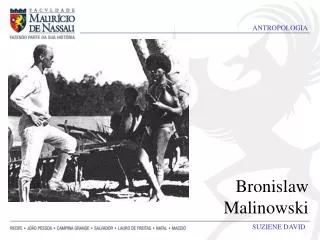
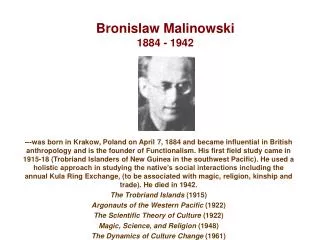
Who was Malinowski and why it matters HIS SON SPEAKS
Modern Anthropology Developed a method. Immersive Fieldwork (Participant Observation) Field note taking. Holistic pursuits. Learning the language. Painstaking documentation. Figure out the social organization. A Functionalism still permeated of evolutionary assumptions Emphasis on present processes Meaning from the perspective of the natives
PARTICIPANT OBSERVATION: Distinction between what people say they do, and what people do. • GOD PROFESSOR • OFF THE VERANDAH
Concern with processes • Trading • Sex Life • Gardening • Enforcement of norms vs self interest. Reciprocity as key to social cohesion. • Rationality • Aspects of a culture can’t be studied in isolation • One can’t relay on rules, but on observation • Importance of context. • Culture as an integrated whole
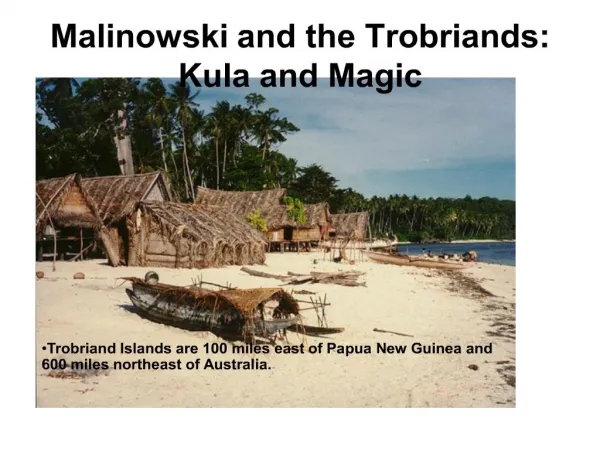
FUNCTIONALISM • Irrational behaviors appear that way because we do not understand them. • What seems irrational is rational from the native’s point of view. • THEY MAKE SENSE TO THEM • THEY HAVE A FUNCTION IN SOCIETY • E.g. The Kula Ring
MAGIC, SCIENCE AND RELIGION: They are complementary MAGIC AND RITUAL • Not preceding science but complementary • Rational response to uncertainty. • Aims at concrete results. • Rooted in observation • Follows rules, formulas and traditions • Requires belief. • Failure is explained by mistakes in application • Authority comes from tradition • Works through ritual and symbolic acts • Healing: causes/ ritual SCIENCE • Also based on obseration and experience • Works through practical knowledge and experimentation • Explains cause and effect. • Tested by trial and error. Empirical. Testable. • Used as technology (fishing, gardening) • Healing: Herbal medicine
SOCIAL CHANGE Societies as static. Failed to account for social change. Only at the end of his life he considered the effects of colonialism.









![get [PDF] ❤Download⭐ A Scientific Theory of Culture and Other Essays (Malinowski](https://cdn7.slideserve.com/12734474/get-pdf-download-a-scientific-theory-of-culture-dt.jpg)