
waterfall mode
E N D
Presentation Transcript
Welcome TO Career Point University Hamirpur
Subject: System Analysis And Design Course Code<CA203>
TopicS • What is Waterfall Model. • History • Where to use • Diagram • Advantages • Disadvantages
Waterfall Model • It is also called as linear sequential model. • It was the first process model. • In this model whole application is developed in sequential approach. • It is very simple to understand and use. • In this model each phase must me completed fully before the next phase begin. • Provides structure to inexperienced staff.
History • The first formal description of the waterfall model is often cited as a 1970 article by Winston W.Royee.. • Royee presented this model as an example of a flawed, none-working model. • It has been widely used for software projects ever since.
Where to use • This SDLC model is used where requirements are very well known. • Where definition is stable. • This SDLC model is used where the technology are understood for the project. • And where new version of an existing product.
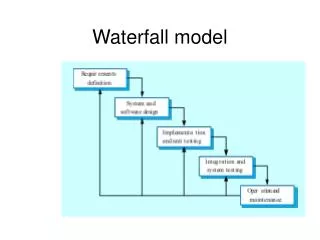
Waterfall Model Diagram Requirements Analysis Design Coding Testing Acceptance
In this phase business analyst will collect the requirements with an interaction of client and collected requirements will be documented. Requirement Gathering In this phase system analyst will study the client requirements and prepare the system requirement specification. Requirement Analysis In this phase design architecture is the responsible to decide architecture of an application in order to full-fill the client requirements. Design In this phase developers will write the program using programming languages or scripting languages in order to develop the application. Coding Initially developers will perform unit testing & integration testing using of white box testing. Testing After the testing the client satisfied on work product then we deliver application to the customer to use at live environment.. Release &Maintenance
Advantages • A waterfall model is easy to implement. • It helps to find errors earlier. • Easy to understand, and easy to use. • Testing is done at every stage. • Works well when quality is more important than cost or schedule. • Documentation is produced at every stage of a waterfall model allowing people to understand what has been doen.
Disadvantages • It is only suitable for the small size projects. • Constant testing of the design is needed. • If requirements may change the waterfall model may not work. • Adjust scope during the life cycle can kill a project. • Difficult to estimate time and cost for each stage of the development process. • High amount risk and uncertainty. • This is not suitable to handle dynamic changes in the requirements.
Thank you