Download
1 / 2
20 likes | 38 Views
Whether you are a dental practitioner, a student, or an interested party, there are several things that you should know about dental electrosurgical units. Among the things you need to know are how to choose one and what to look for when buying one.

E N D
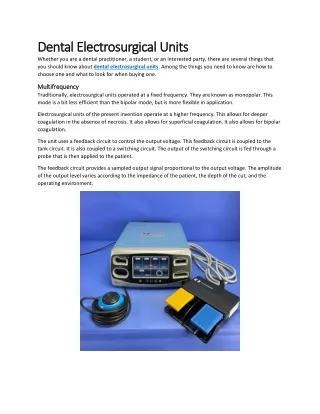
Dental Electrosurgical Units Dental Electrosurgical Units Whether you are a dental practitioner, a student, or an interested party, there are several things that you should know about dental electrosurgical units. Among the things you need to know are how to choose one and what to look for when buying one. Multifrequency Multifrequency Traditionally, electrosurgical units operated at a fixed frequency. They are known as monopolar. This mode is a bit less efficient than the bipolar mode, but is more flexible in application. Electrosurgical units of the present invention operate at a higher frequency. This allows for deeper coagulation in the absence of necrosis. It also allows for superficial coagulation. It also allows for bipolar coagulation. The unit uses a feedback circuit to control the output voltage. This feedback circuit is coupled to the tank circuit. It is also coupled to a switching circuit. The output of the switching circuit is fed through a probe that is then applied to the patient. The feedback circuit provides a sampled output signal proportional to the output voltage. The amplitude of the output level varies according to the impedance of the patient, the depth of the cut, and the operating environment.
Fixed freque Fixed frequency Using an electrosurgical unit can be an excellent way to perform soft tissue surgical procedures. However, it is important to select the correct device for the application. ncy For a surgical procedure, a higher frequency electrosurgical unit is likely to be the better choice. These units produce less lateral heat and alter less tissue than a lower frequency unit. They also require less skin contact. The power level is also an important consideration. This level can be set by the clinician. The power level is a measure of the amount of electricity produced by the electrosurgical unit. It can be read from dual digital display systems. The most efficient electrosurgical unit will use the least power possible. This will decrease the risk of electrode breakage and tissue adhesion. Monopolar mode Monopolar mode Typically, monopolar and bipolar electrosurgical units operate at a fixed frequency. The monopolar unit is used for a variety of modalities, while the bipolar unit is more commonly used for soft tissue surgical procedures. Monopolar electrosurgery is a surgical technique using one active electrode and one neutral electrode in the surgical site. The monopolar mode is used in cases where there is a need for pure hemostasis. In this method, the electrical current flows from the active electrode to the neutral electrode, and the patient becomes an integral part of the circuit. In the bipolar mode, there are two active electrodes, one at the surgical site and one near the patient. In this mode, the electrical current flows from the active electrode through the patient's body to the neutral electrode. It is important to remember that the current concentration is lower when the distance from the active electrode is increased. Case reports of mo Case reports of monopolar electrosurgical unit nopolar electrosurgical unit Performing dental procedures with a monopolar electrosurgical unit involves careful observation and considerable knowledge. The advantages of electrosurgery include minimal cost and good patient satisfaction. However, some complications can arise. Electrosurgical burns occur when the active electrode touches a narrow structure. The voltage must be increased to maintain the desired tissue effect. This increases the risk of unintended burns. Monopolar electrosurgery uses a distant electrode that contains an electron reservoir. This electrode is typically attached to the same probe tip as the active electrode. The active electrode is a blade-shaped electrode that directs the electrical current to the patient's body. The dispersive electrode is typically a large metal plate attached remotely to the patient. The dispersive electrode is responsible for defocusing the RF current and preventing thermal injury to the underlying tissue.