Download
1 / 4
0 likes | 19 Views
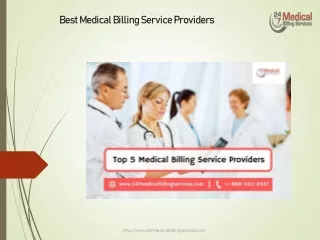
Medical billing services manage claims submissions, insurance verification, coding, and payment collection to ensure that healthcare providers receive timely reimbursements. They manage the revenue cycle, reducing errors, improving cash flow, and allowing providers to focus on patient care. In-house or outsourced, these services streamline processes, ensure compliance, and minimize administrative burdens, making them essential for efficient healthcare operations.

E N D
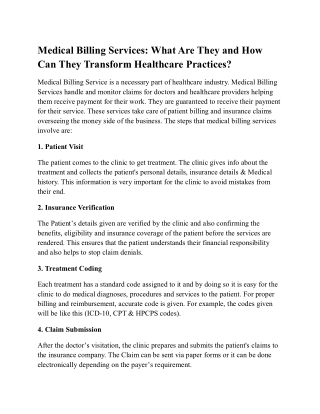
Medical Billing Services: What Are They and How Can They Transform Healthcare Practices? Medical Billing Service is a necessary part of healthcare industry. Medical Billing Services handle and monitor claims for doctors and healthcare providers helping them receive payment for their work. They are guaranteed to receive their payment for their service. These services take care of patient billing and insurance claims overseeing the money side of the business. The steps that medical billing services involve are: 1. Patient Visit The patient comes to the clinic to get treatment. The clinic gives info about the treatment and collects the patient's personal details, insurance details & Medical history.This information is very important for the clinic to avoid mistakes from their end. 2. Insurance Verification The Patient’s details given are verified by the clinic and also confirming the benefits, eligibility and insurance coverage of the patient before the services are rendered. This ensures that the patient understands their financial responsibility and also helps to stop claim denials. 3. Treatment Coding Each treatment has a standard code assigned to it and by doing so it is easy for the clinic to do medical diagnoses, procedures and services to the patient. For proper billing and reimbursement, accurate code is given. For example, the codes given will be like this (ICD-10, CPT & HPCPS codes). 4. Claim Submission After the doctor’s visitation, the clinic prepares and submits the patient's claims to the insurance company. The Claim can be sent via paper forms or it can be done electronically depending on the payer’s requirement.
5. Payment Posting The payment made by the patient and the insurance company are recorded. This helps to reconcile payments and ensures that the amount paid align with the service provided by the clinic. 6. Claim Follow-Up The clinic gets in touch with the insurance team about any problems with the patient's claim. When the insurance team takes too long or turns down the claim, the clinic steps in to fix the issue for the patient. 7. Patient Billing Insurance companies handle payments for the treatments that are covered under their plans. The clinic generates and sends bills to patients for their Co-pay, deductibles and any non-covered services which are covered outside their insurance coverage. This transparent communication about billing enhances patient’s satisfaction. 8. Reporting and Analyzing The Billing data is reviewed by the healthcare providers, by doing so helps them evaluate revenue performance, spot patterns and find areas to improve. These reports guide them to make smart financial decisions. Benefits of Medical Billing Services Improved Cash Flow: An effective billing process improves the cash flow which leads to quicker payments and reduces days in accounts receivable. Reduced Claim Denials: Medical Billing professionals are very good at minimizing errors at lead to claim denials. Cost Saving: Costs that are associated with hiring and training the in-house staff which is associated with overhead cost can be reduced by giving them to outsourcing medical team.
Focus on Patient Care: By reducing the time on billing process and paper work, doctors and staffs can now focus that time for patient care. Expertise: The Knowledgeable staff of the Professional billing service who stay updated on the compliance issue, coding regulation & payer policies. Types of Medical Billing Services The types of Medical Billing Services include: In-house Medical Billing: The In-house Medical Billing refers to the billing process managed by the internal team in the healthcare facility. They are hired and trained by the internal team of the healthcare facility to handle patient billing, insurance claim and other related tasks. Outsourced Medical Billing: The Outsourced Medical Billing refers to the billing process managed by hiring external staff from third party vendors or other companies. These Outsourcing companies provide services such as payment processing, claim submissions and accounts receivable management to the healthcare facility. Hybrid Model: It is a combination of both the In-house Medical Billing service and Outsourced Medical Billing service. By doing so, it allows flexibility based on the facility needs. Choosing a Medical Billing Service Transparency: The Service provided should offer clear pricing and regular report on the billing process. Experience & Expertise: Look and select the provider with your specific medical specialty and strong track record. Technology & Software: Check to see that they are using up-to-date billing software that blends well with your practice management system. Customer Support: For addressing concerns and resolving issues it is crucial to have effective communication and support.
Compliance: The Provider must comply with HIPAA regulations and prioritize data security. Medical Billing Services plays an important role in the healthcare ecosystem, streamlining the intricate process of financial management and reimbursement. Medical Billing Services make it easier to handle claims and payments. This helps healthcare providers receive accurate payments on schedule allowing them to concentrate on giving their patients top-notch care.By doing these services healthcare providers can improve their cash flow, operational efficiency and focus more on patient care.