Download
1 / 53
590 likes | 760 Views
eople usually forget that even if they donu2019t follow fashion, or donu2019t care about it in general, they think about it anyway every morning when they wake up and have to go out, whether itu2019s for work, for school or for fun.<br>Fashion is not only fancy dresses or overpriced pieces of accessories, itu2019s not just a matter of trends to follow. What we wear isnu2019t simply clothes. They are what we are and what we feel, they are an expression of what and who we want to be and how we want to approach the world. Even the legendary Coco Chanel ones said: u201cFashion is not something that exists in dresses only u2026

E N D
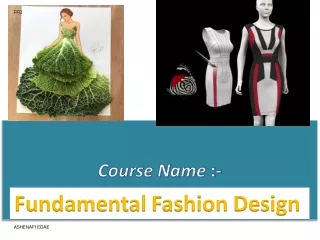
FFD Fundamental Fashion Design ASHENAFI EDAE
FFD Course Code GART 2051 Credit hours 3 Cr.Hrs/ 5ECTS GARMENT TECHNOLOGY • Lecturer AT ETU ASHENAFI EDAE
FFD • Please, for your and your colleagues’ health: please read the COVID-19 information ASHENAFI EDAE
FFD Aim / Course objective At the end of the course, students will be able to: Explain the terminologies used in fashion Identify the elements and principles of design Apply the elements and principles of design in garments Identify elements of garment fashion Develop mood/ Inspirational Boards ASHENAFI EDAE
Fundamental Fashion Design The Overview of Fashion and Apparel aesthetics, clothing construction FFD :-Fashion Other Definition design is the art of applying design, and natural beauty to clothing and its accessories. ASHENAFI EDAE
FFD Fundamental Fashion Design • Definition :_the Fundamentals of Fashion Design provides a fully illustrated introduction to the key elements of fashion design, from the initial concept of a fashion idea to realizing it in 3D form. Writing with clarity and precision ASHENAFI EDAE
FFD Fundamental Fashion Design cont`d Fashion It is influenced by culture and different trends, and has varied over time and place. "A designer CREATES fashion clothing, including dresses, suits, pants, and skirts, and accessories like shoes and handbags, for consumers. He or she can specialize in clothing, accessory, or jewelry design, or may work in more than one of these areas. ASHENAFI EDAE
Fundamental Fashion Design cont`d FFD Fashion designers work in a variety of different ways in designing their pieces and accessories such as rings, bracelets and necklaces. Because of the time required to bring a garment onto the market, designers must at times anticipate changes to consumer desires. Fashion designers are responsible for creating looks for individual garments, involving shape, color, fabric, trimming, and more. Fashion designers play a major role in our world. Their talent and vision play a big role on how people present themselves. They influence society and the way they choose to express themselves. ASHENAFI EDAE
FFD CHAPTER- 1 Introduction to Fashion history • History of fashion design refers specifically to the development of the purpose and intention behind garments, shoes and accessories, and their design and construction. The modern industry, based around firms or fashion houses run by Born Bourne, Lincolnshire, England Died 10 March 1895 (aged 69) Paris, France Nationality English Occupation Fashion designer Known for Creating haute couture Label(s) House of Worth Spouse(s) Marie Augustine Vernet (1825–1898)[1] Children Gaston Lucien, Jean Philippe[1] Parent(s) William Worth and Ann Worth, née Quincey[1][ 13 October 1825 individual designers, started in the 19th century with Charles Frederick Worth who, beginning in 1858, was the first designer to have his label sewn into the garments he created ASHENAFI EDAE
FFD Introduction to Fashion History • Charles Frederick Worth (13 October 1825 – 10 March 1895) was an English fashion designer who founded the House of Worth, one of the foremost fashion houses of the 19th and early 20th centuries. He is considered by many fashion historians to be the father of haute couture. haute couture. • Worth is also credited with revolutionizing the business of fashion. ASHENAFI EDAE
FFD CONT… Haute couture French pronunciation: French for 'high sewing', 'high dressmaking') is the creation of exclusive custom-fitted clothing. Haute couture is high-end fashion that is constructed by hand from start to finish, made from high-quality, expensive, often unusual fabric and sewn with extreme attention to detail and finished by the most experienced and capable of sewers—often using time-consuming, hand-executed techniques ASHENAFI EDAE
FFD 1.1 Fashion History of European • Fashion in the period 1500–1550 in Western Europe is marked by voluminous clothing worn in an abundance of layers (one reaction to the cooling temperatures of the Little Ice Age, especially in Northern Europe and the British Isles). Contrasting fabrics, slashes, embroidery, applied trims, and other forms of surface ornamentation became prominent. The tall, narrow lines of the late Medieval period were replaced with a wide silhouette, conical for women with breadth at the hips and broadly square for men with width at the shoulders. Sleeves were a centre of attention, and were puffed, slashed, cuffed, and turned back to reveal contrasting linings. ASHENAFI EDAE
FFD Working class clothing ASHENAFI EDAE
FFD Children’s clothing • Children’s clothing during the Italian Renaissance reflected that of their parents. In other words, kids dressed exactly like the adults and looked like miniature versions of them. As babies and toddlers, children were all put in dresses to make the potty training process easier for parents or maids. Then, around the age of 6 or 7, boys would receive their first pair of hose (called breeching). ASHENAFI EDAE
FFD 1. 2. Fashion History of Asia • East Asia includes the present countries of China, Korea, Japan, and Vietnam (the latter also can be considered part of Southeast Asia), along with adjacent areas of Inner Asia that have historically sometimes been part of the Chinese empire and often have heavily culturally been influenced by China. ASHENAFI EDAE
FFD Fashion History of Asia The technology of silk production and the cultural preference for wearing silk were exported from China to Korea, Japan, and Vietnam. Silk cloth (but not, except by accident or industrial espionage, silk technology) was exported regularly and in large quantities from China to Central and Western Asia along the Silk Route beginning in the first century Chinese couple, circa 1880 ASHENAFI EDAE
FFD Fashion History of Asia The dragon robes of late imperial China conveyed, through color and design details, precise information about the rank of those who wore them. Similar information for lower-ranking officials was conveyed through Mandarin squares, embroidered cloth badges that showed a wearer's civil service rank and were worn on the front and back of official robes. ASHENAFI EDAE
Cont… FFD The region's "traditional" textiles include tube skirts, shawls, blankets, and other items that have as their feasible model weaving on back-tensioned looms with circular warps. These can be elaborated in a variety of ways, using resist tie-dyed warp or weft elements, intricate supplementary weft or warp floats, tapestry weaves, appliqués, embroideries, and other methods. ASHENAFI EDAE
FFD ASHENAFI EDAE
World War II FFD • A pivotal world event occurred in the late 30s and through the 1940s: World War II. • It deserves special recognition here because of its effect on the era’s fashion. • Many of us have lived in countries at war, but few have seen a country devote its entire industry to a war effort, known as “totalwar”. Total war in the USA resulted in Can you believe that these turned into parachutes? Image courtesy of Pexels shortcomings in many areas of life, including fashion. Fabric was used for other purposes, such as parachutes, rope and netting, so certain clothing items disappeared from store shelves. Women, for instance, could no longer find stockings (also known as “hosiery”). ASHENAFI EDAE
FFD So, the logical thing to do would be to stop wearing stockings until the end of the war, right? Of course not! Americans treated fashion during the war as they did with life in general: they tried to maintain a sense of normalcy in difficult times. Amazingly, women adapted by painting on their hosiery! At first, they used foundation, with black eyeliner pencils to draw the “seam.” Later, special products - such as “liquidstockings” and “legmakeup” - came out. ASHENAFI EDAE
FFD 1950s: Post War Era After World War II, fashion rebounded to the forefront of American culture in the 1950s. The decade was marked by an economic boom and a giant push towards consumerism, a trend that continues today. Once WWII came to an end, rationing became a thing of the past, as the availability and For men, 1950s fashion was not very accessibility of several different types of fabrics different from that of previous decades. became the norm. Men often wore suits, sweaters, casual It was during this decade that department stores button-downs, and slacks, all made of gained popularity across the country, providing similar fabrics. Unlike in the 1920s, Americans with access to a wide range of men avoided patterns, electing instead consumer goods. for solid colors. ASHENAFI EDAE
FFD Cont… Women of the 1950s were expected to look and dress a certain way and many, for the most part, conformed to this newly established standard of beauty, unlike the fashion- forward, independent flappers of the Roaring 20s. As their husbands returned from war, the American women of the 1950s were expected to focus on their role as homemakers. Conformity among women was highly encouraged, eliminating the need for dramatically different styles. During this decade, hemlines dropped significantly, reaching mid-calf or even ankle length while the popularity of the hourglass silhouette rose. Dresses with flowing, bright colored skirts became the standard for suburban housewives. For working women, the much more form-fitting knee-length pencil skirt was often worn, ASHENAFI EDAE requiring a tight girdle in order to emphasize the hourglass figure.
FFD • In the 1970s, Enolliah Williams worked as a housekeeper in a mansion in Baltimore that had recently been acquired by the Maryland Historical Society. As she tidied up, she discovered dozens of beautiful garments scattered throughout the house’s nooks and openings. She became fascinated with these garments, which dated all the way from the early 18th century to the ASHENAFI EDAE 1960s.
FFD Cont… • Though not trained as a curator or historian, Williams did her best to catalog the garments she found, and for decades patiently placed them in boxes and organized them by date and style. She lined drawers to organize stray buttons and lace. On 4 x 5 cards, she recorded details about each item, slowly documenting a collection of 12,000 individual outfits and costumes. She didn’t realize it at the time, but she was preserving one of the largest collections of American garments in the country. ASHENAFI EDAE
FFD The United States is one of the leading countries in the fashion design industry, along with France, Italy, the United Kingdom, Germany and Japan. Apart from professional business attire, American fashion is eclectic and predominantly informal. While Americans' diverse cultural roots are reflected in their clothing, particularly those of recent immigrants, cowboy hats, boots, jeans, and leather motorcycle jackets are emblematic of specifically American styles. New York City and Los Angeles are the centers of America's fashion industry. They are considered leading fashion capitals. New York City is generally considered to be one of the "big four" global fashion capitals, along ASHENAFI EDAE with Paris, Milan and London.
cont,d FFD From the mid-1960s, men’s fashion was military elements, with many of the rock influences contributing to its popularity. Mick Jagger (Fig. 26) and Jimi Hendrix (Fig. 25) both sported military jackets performances, Beatles’ 1967 Pepper’s Lonely Hearts Club Band showed the band. influenced by during The Sgt. while album ASHENAFI EDAE
3. Fashion History of America FFD ASHENAFI EDAE
FFD Cont… Boy’s fashion saw the popularity of denim and plaid throughout the decade. In the early 1960s, cuffed jeans and corduroy pants were favorites paired with tucked in polo shirts and athletic jackets or blazers. As the decade progressed, the color and pattern that was seen in men’s clothing began to slowly creep into young boy’s fashion Striped and plaid blazers were popular formal options, while turtlenecks, a popular style among men, and brighter colors such as red, yellow, and orange were worn in the mid-sixties. Neither girl’s nor boy’s fashion saw a strong influence from hippie fashion, although some boys began to wear bell-bottom jeans in the later part of the decade. ASHENAFI EDAE
3. Fashion History of America FFD French colonists in the Colonial United States wore European fashions from the land of their origin. The pilgrims of Plymouth colony adopted the new English fashion of King Charles I, the falling band collar made of lace or linen. Men's attire consisted of a linen undergarment, a padded button-down doublet with long sleeves, sometimes worn with cloth collars and white cuffs that contrasted with dark colored garments, baggy knee length breeches, and knee-length stockings of cotton or wool. Fig. Pierre Cardin (French, 1922-). Miniskirt, 1969. Wool, plastic. New York: : The Metropolitan Museum of Art ASHENAFI EDAE
Fashion History of America FFD Felt hats were worn at all times, even indoors. Women wore a short-sleeved linen undergarment tied with ribbons, stays, ankle length petticoats (sometimes multiple layers), a fitted gown or fitted button down bodice (sleeves could be sewn on or attached at the shoulder with a ribbon) with an ankle length skirt, stockings and aprons. Pilgrim women always wore their hair pulled back and covered with a cap called a coif. Fig. 7 - Unknown. Jean Shrimpton and Celia are wearing Mary Quant designs, ca. 1960s. Kristine. Source: Flickr ASHENAFI EDAE
4. Fashion History of Africa FFD ASHENAFI EDAE
4. Fashion History of Africa FFD In the past, the royal family could only use Kente in gold. To date, however, no Ashanti will wear royal clothing in the presence of Asantehen. • The king should always have with him the best collection of Kente and Adinkra in the world. • . ASHENAFI EDAE
FFD ASSIGNMENT -I 1. 2. 3. 4. 5. 6. 7. 8. 9. 10. 1980s in fashion 11. 1990s in fashion 12. 2000s in fashion 13. 2010s in fashion 14. 2020s in fashion 1880s in fashion 1890s in fashion 1900s in fashion 1910s in fashion 1920s in fashion 1930–1945 in fashion 1945–1960 in fashion 1960s in fashion 1970s in fashion ASHENAFI EDAE
FFD Chapter: 1 1.Fashion Terminology 1. 1.1. High fashion 1.2. Mass fashion 1.3. Style of fashion 1.4. Design 1.5. Style 1.6. Fad fashion 1.7. Classic fashion ASHENAFI EDAE Introduction to fashion terminology
FFD High fashion • Fast fashion is a term used to describe a highly profitable business model based on replicating catwalk trends and high-fashion designs, and mass-producing them at low cost. • The term fast fashion is also used to generically describe the products of the fast fashion business model ASHENAFI EDAE
FFD ASHENAFI EDAE
FFD High fashion ASHENAFI EDAE
FFD High fashion ASHENAFI EDAE
FFD HIGH FASHION Clothing that is considered high fashion is made by well- known designers. Often, the designers name is connected to the clothing labels and contributes to its value. High-fashion items are commonly sold through boutiques and specialty shops as opposed to large discount or department stores. However, discount chain Target has managed to create agreements with prominent high-fashion designers to develop exclusive, affordable lines for the store. ASHENAFI EDAE
High End Fashion FFD Designer clothes are made of high quality materials from Fashion Boutique and so they are a lot superior that other types of clothing. They are for the most part more durable. For those people who are looking for values in clothing products, these high end fashion designers have seen this need since most people today buy cheap items which are easy to discard. ASHENAFI EDAE
FFD CONT. Companies like H&M and Zara, built business models based on inexpensive clothing from the efficient production lines, to create more seasonal and trendy designs that are aggressively marketed to fashion-conscious consumers. Fast fashion applies an extreme version of planned obsolescence to clothing. Because these designs are changing so quickly and are so cheap, consumers buy more clothing than they would previously, so expectations for those clothes to last decrease. ASHENAFI EDAE
FFD CONT. This decrease in quality, increase in purchasing, and speed of replacement creates a large amount of clothing waste— much clothing produced under the fast fashion model is lower quality thus harder to reuse or recycle. ASHENAFI EDAE
FFD High fashion Moreover, the rapid and cheap production processes of fast fashion create increased pollution and other environmental and social impacts—i.e. pesticide use in industrial cotton growth, fossil fuel extraction for synthetic materials or slave labour in sweatshops. In response to these impacts, environmentally or socially responsible consumers and designers have begun demanding zero-waste fashion or sustainable fashion. This increasing trend ASHENAFI EDAE
FFD Cont… ASHENAFI EDAE
High fashion FFD H&M is a Swedish multinational clothing-retail company known for its fast-fashion clothing for men, women, teenagers, and children. As of November 2019, H&M operates in 74 countries with over 5,000 stores under the various company brands, with 126,000 full-time equivalent positions. It is the second-largest global clothing retailer, behind Spain-based Inditex (parent company of Zara). ASHENAFI EDAE
FFD Some example of Shop outlet H&M Asia flagship store at Causeway Bay, Hong Kong H&M Store at Costanera Center Shopping Center, Santiago, Chile. ASHENAFI EDAE
Mass fashion FFD Mass Production in the Fashion Industry: How quantity outweighs quality and leads to waste and financial loss The garment industry has undergone numerous changes, as it started its transition from traditional design and manufacturing processes, to an innovative, fully-digitalized workflow. This literal metamorphosis forces major retailers to be cost competitive and flexible, offering greater varieties, exceedingly fast time to market, and garments at more affordable prices. But at what cost? Speed is the key to mass production in today’s garment supply chain. Used by large retailers, including some of the world’s biggest brands, the concept of mass production, does not disappoint. ASHENAFI EDAE
Cont… FFD Fast, affordable, reaching the end customer in record time, and keeping inventory to a minimum. This scenario seems no less than idyllic – reliable success; high-profit margins for retailers on one end, and satisfied end customers on the other. But mass production in the fashion industry has had a direct effect on the quality of every garment, on the fabrics and textiles used in production, and the value of the finished product. Mass production, although yielding an immense selection, has also led to huge amounts of waste. Unused, unsold garments are not only polluting our environment, they represent huge financial losses for every cog in the supply chain – from manufacturers to distributors to retailers. ASHENAFI EDAE
FFD Mass fashion Quantity vs. Quality • Not too long ago, when the average consumer put price above all else, cheaply made mass produced garments made sense. Since the dawn of the brick-and-mortar store along with modern-day marketing, consumers became proficient in purchasing garments on sale, with the promise of quality clothing at a reduced price. • According to Quality over Quantity: Consumers Weigh Well-Made Apparel vs. Fast Fashion, when mass production, aka fast fashion, came into the fore, throwaway clothes were at the top of everybody’s shopping list. • There were cheaply made garments that were purchased and briefly worn, prior to being trashed. ASHENAFI EDAE