Job Redesign
This Top down and bottom up approach, Job

Job Redesign
E N D
Presentation Transcript
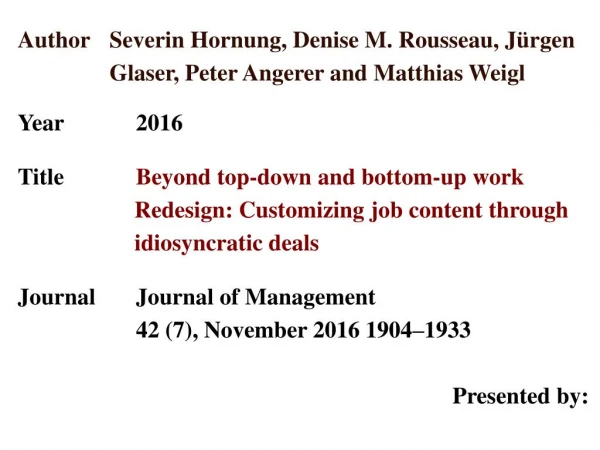
Author SeverinHornung, Denise M. Rousseau, Jürgen Glaser, Peter Angerer and Matthias Weigl Year 2016 TitleBeyond top-down and bottom-up work Redesign: Customizing job content through idiosyncratic deals Journal Journal of Management 42 (7), November 2016 1904–1933 Presented by:
INTRODUCTION • Task Idiosyncratic (uncommon) Deal (I-deals) is a third approach that individuals negotiate to create or alter their own job’s contents. • An employee is assigned tasks that make a flexible schedule or alternate work location more appropriate. • In response to receiving an I-deal, an employee usually is more emotionally committed to the job, and will go above and beyond in trying to help the company. • I-deals have become more readily negotiated as employers face market pressures to both attract and retain talent (Cappelli, 2000)
INTRODUCTION - Example A marketing Manager, must develop the company’s marketing strategy over two months, while working at an office in Karachi. However, there are exceptions to this typical work arrangement. An employee may be assigned additional roles or tasks that make a flexible schedule or alternate work location more appropriate. Despite the fact that the employee was originally expected to work eight hours a day from the Lahore Office, the employer agrees to allow this employee to work from any location. These exceptions to employer-employee work arrangements are known as idiosyncratic deals or “i-deals.”
APPROACHES TO WORK DESIGN • Job or work (re-)design typically refers to setting up or modifying tasks in ways that benefit workers and their employer (Hackman & Oldham, 1975, 1980). • These benefits include intrinsically satisfying work and greater well-being for employees, along with gains in employee attendance, retention, performance, and pro-activity that employers value (e.g., Fried & Ferris, Parker, Turner, & Griffin, 2003) • All work design approaches are grounded in assumptions regarding where the authority to determine job contents.
TOP-DOWN AUTHORIZATION - FROM JOB DESIGN PROGRAMS TO NEW JOB CRETION • Formal job design programs place the authority for job structure with management. • Traditional top-down job redesign limits individualization, emphasizing instead optimum configurations of duties and demands for the average job occupant. • Managers can authorize individually customized idiosyncratic jobs to accomplish a new task or otherwise capitalize (take advantageous) on an individual worker's skill.
BOTTOM-UP EXERCISE OF LEGITIMATE ACTION • Workers themselves can redefine, modify, and renegotiate their job roles and duties from the (Grant & Parker, in press; Parker & Collins) • Job crafters modify their job's contents and its relational boundaries to add meaning and meet personal needs, or impact others the worker care about (e.g., a hospital janitor taking time to chat with anxious pre-op patients) • Although job crafting principally refers to constructive, legitimate actions, it is not explicitly authorized by the employer .
THE MIDDLE GROUND - AUTHORIZATION VIA INDIVIDUAL NEGOTIATION • Personal flexibility and development are two commonly negotiated types of I-deals. Flexibility I-deals personalize work schedules; development I-deals are special opportunities for skill acquisition and advancement. • Tasks i-deals constitute a middle path between top-down work redesign and a single worker's private efforts to craft a job. • Workers are limited in the extent they can substantially change their requisite duties without authorization. If approval is required to do so, employees must influence their employer.
WORK REDESIGN THROUGH IDIOSYNCRATIC DEALS • Task i-deals can be used to make work duties and demands more matching with personal goals, thus improving person-job fit (P-J fit; Edwards, 1991; Kulik, Oldham, and) Hakman 1987. • Employers and their agents (HR or Supervisor) tend to agree to task i-deals that meet their own interests such a valued worker seeking arrangements not covered by the firm's standard offering. • Task i-deals can establish new precedents that ultimately form broader changes in job design
Comparison of Work Design Concepts and Their Dimensions The three contrasted job design approaches differ in their theoretical and practical implications. But, task i-deals offer a practical alternative and to more recognized forms of Job Design
THEORY • 1- The leader–member exchange (LMX) theory is a relationship-based approach to leadership that focuses on the two-way relationship between leaders and followers. • 2- Personality-job fit theory revolves around the idea that every organization and individual has specific personality traits. The best personality fit will also decrease job turnover and stress, absenteeism, and poor job satisfaction. Person-environment fit is a match between a worker's abilities, needs, and values and organizational demands, rewards, and values.
LT. REVIEW AND HYPOTHESES • Task I-deals are authorized by the employer or its agents (e.g., higher levels managers, resources), typically the immediate supervisor. • In this context, leader-member exchange (LMX) provides a relational and describes the degree of social exchange in the supervisor-relationship. • Workers who are especially valued and trusted by their supervisors have more flexible or expandable zones of Acceptance. • High LMX relationships imply greater interpersonal support. • HI: Employee perceptions of LMX will be positively related to the extent of task I-deals.
LT. REVIEW AND HYPOTHESES • For workers, task i-deals offer a way to improve P-J fit, thus enhancing personal need satisfaction and well-being. • Three established dimensions along which Job can vary are: (a) complexity, (b) control and Stressors. • Job characteristic models typically include forms of complexity and control to describe conditions that stimulate intrinsic motivation, learning, and personal growth, thus supporting worker well-being, mental health, performance; decision authority and skill discretion. • Work stressors are theoretically distinct from complexity and control that need not be inherent in the task • H2: The extent of task i-deals will be positively related to complexity (H2a) and control at work (H2b)
LT. REVIEW AND HYPOTHESES • Work stressors are avoiding characteristics of Jobs. Unlike complexity in the task itself, stressors complicate job performance and overtaxing the individual worker. • Work stressors indicate discrepancies between working conditions and individual's capacity to effectively respond to related barriers. • Negotiations Task i-deals to reduce stressors is form of active coping with detrimental job features • H3: The extent of task I-deals will be negatively related to work stressor.
LT. REVIEW AND HYPOTHESES • To increase P-J fit by customizing work features, task I-Ideals are expected to positively affect personal initiative (PI) and work engagement (WE) • PI is foremost a performance concept and indicator of active mental health. • WE is an active state of work-related subjective well-being, and positively relate to performance. • PI and WE as positive work outcomes balances the benefits to employee and employer from optimizing P-J fit. • H4: Complexity and control at work will be positively related to PI (H4a) and mediate positive indirect effects of task I-deals on PI (H4b)
LT. REVIEW AND HYPOTHESES • Engaged workers display high energy, identify strongly with their jobs, and experience flow-like states at work. • Complexity and control are expected to be positively and stressors negatively related to WE • If task i-deals are used to increase fit between personal needs or goals and their fulfillment during work activities, they are likely to enhance WE • By making tasks more intrinsically motivating and less stressful, task i-deals are expected to enhance engagement through positive effects on work characteristics • H5 : Complexity and control at work will be positively (H5a) and work stressors negatively (H5b) related to WE; complexity, control, and stressors will mediate positive indirect effects of task i-deals on WE (H5c).
METHOD Study 1 examined relationships between LMX, task i-deals, work characteristics (complexity and control) and PI among hospital workers in the United States, testing hypotheses HI, H2, and H4. Study 2 aims to replicate HI and H2. Using an expanded set of work characteristics (complexity, control, and stressors) and WE as an outcome, it further tests H3 and H5. Study 2's sample of German hospital physicians examines the generalizability of Study l's findings to a different occupational and cultural context. Study 1
METHOD TARGETPOPULATION ST 1 : Hospital Workers, except Physicians in United States ST 2 : Hospital Physicians in Germany DATA COLLECTION Questionnaire based Survey is conducted in one shot. ACTUAL SAMPLE • Study One • 400 survey forms were distributed among US Hospital workers • 207 responded (47.3% response rate) • Study Two • 292 survey forms distributed among Germany Hospital Physicians • 159 responded (46.2% response rate) 3
DISCUSSION • In the current study, overall, we found that task i-deals have links to LMX, work characteristics, PI, and WE, supporting their relevance to research on leadership, job design, proactive behavior, and worker well being. • The opportunity to create task i-deals appears to partly depend on the quality of the supervisory relationship, indicative of a worker's bargain position and flexibility in the zone of acceptance attributed by his or her manager • Facilitated by high LMX, workers can negotiate to make their tasks more challenging, self-determined and less stressful. Intrinsically motivating and healthy job characteristics, in turn, relate performance and engagement at work. • Results support our theory that task i-deals are a form of worker-initiated redesigned to increase P-J fit.
DISCUSSION • The finding that task i-deals relate negatively to stressors, but positively to work corresponds with the distinction of hindrance and challenge stressors. • Study 2's structural model was a negative association with LMX (r=.31P< 0.01) • Workers with a high-quality supervisory relationship were less likely to be turned down. • Finding on LMX, special work arrangements seem to be a matter of bargaining power and social relationships.
CONCLUSION Work design is not a homogeneous process. It can be achieved via several means and impacts multiple constituents, raising the question: "Design in whose view?" (Weick, 2001, p. 65). The redesign interests of workers and employer converge in individually negotiated task i-deals. They address a fundamental issue in job design theory and practice, how to resolve tensions between authority exercised by the employer and employee needs for self-determination and personal growth. A form of influence workers apply on an employer, i-deals reflect the contemporary shift in risk and responsibilities from employers to individual workers. As such, task i-deals are a means to expand the theory and practice of job design to reflect fundamental changes in the employment relationship itself.