Download
1 / 27
300 likes | 1.17k Views
Sedimentary Rocks. John Day Fossil Beds Natl. Mon.,Oregon. Sedimentary rocks composed of sediment (particles derived by weathering). Detrital sediments particles derived by physical weathering

E N D
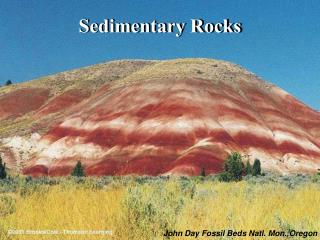
Sedimentary Rocks John Day Fossil Beds Natl. Mon.,Oregon
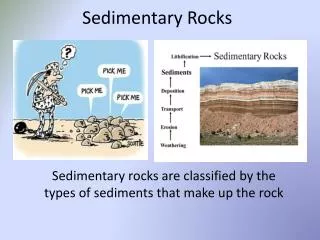
Sedimentary rocks composed of sediment (particles derived by weathering)
Detrital sediments particles derived by physical weathering • Non-detrital sediments minerals precipitated from solution by inorganic chem. processes or activities of organisms Classification of Sedimentary Particles SizeSediment Name >2 mm gravel 1/16-2 mm sand 1/256-1/16 mm silt <1/256 mm clay
Why Should You Study Sedimentary Rocks? • Sediments are the most common Earth materials. • Rock Features record environmental conditions at the time sediment was deposited. (impt. in deciphering Earth history) • Fossils knowledge of pre-existent life preserved in sedimentary rocks • Some sed. rocks contain resources (i.e. water, petroleum, natural gas, etc.).
Transport & Deposition Ice -- carries particles of any size. Wind -- transports sand & smaller particles. Water (most prolific agent) Larger particles require more vigorous current for transport. • Depositional environment geographic area where sediment accumulates
well-rounded, poor-sorted gravel angular, poor-sorted gravel • Rounding -- abrasion during transport reduces particle size & smoothes sharp corners • Sorting -- variety of particle sizes present in sediment or sed. rock (influenced by transport & depositional processes)
Processes (Physical, chemical, & biological) operating in the depositional environment impart distinctive charac. to accumulating sediment.
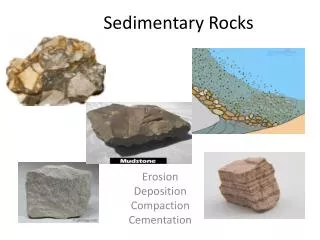
How Are Sediments Transformed into Sedimentary Rocks? Compaction • due to weight of overlying sediment • particles pack more closely & pore space is reduced • deposit’svolume reduced Cementation • binds one particle to anotherby chemical precipitation of minerals in sediment pore space. • {Common cements include quartz, calcite, & hematite.} Lithification • involves compaction & cementation • converts sediments to sedimentary rocks
Detrital sedimentary rocks comprised of solid particles derived from parent material by phys. weathering Classification of Detrital Sed. Rocks Based on: Sediment Size Composition
Conglomerate = rounded gravel (>2 mm) Breccia = angular gravel A B
Sandstone = sand-size (1/16 - 2 mm) particles • classified by mineralogy Quartz sandstone most common Arkose sandstone 25% feldspar
Mudrock any combination of silt & clay Siltstone silt (1/16 – 1 / 256 mm) Claystone clay (< 1 / 256 mm) • Shale is fissile clay. (splits along many closely spaced planes) • Mudrocks = most common sed. rock (quiet-water environ) shale
Chemical sedimentary rocks ions taken into soln by weathering of parent material **crystalline texture (interlocking mineral grains) Biochemical sedimentary rocks Organisms aid in the precipitation of minerals. Classification of Chemical Sed. Rocks Based on: Mineral composition Texture
Evaporites formed by precipitation of minerals from evaporating water \ Rock salt{halite (NaCl)} (A) & Rock gypsum{gypsum (CaSO4. 2H2O)}(B) are most common. B A
Limestones composed of Calcite (CaCO3) contains much pore space Coquina Clastic texture shell fragments Fossiliferouslimestone skeletal fragments of marine invertebrates -- pores filled w/ cement & mud --
Coal crystalline texture carbon (compressed, altered plant remains that occupied swamps & bogs) A B Chert crystalline texture silica (layers of microscopic shells of marine organisms)
Strata (beds)layers differ in color, texture, & comp. from rock layers above & below. Sedimentary Facies -- sets of sed. rock w/ distinct attributes imparted by their depositional environment Coastal areas facies accumulate simultaneously on various areas of seafloor (w/ unique charac.).
1 Regression(seaward shift in the shoreline) • Drop in sea level Nearshore deposits overlie offshore deposits. 2 3
Transgression (landward shift in shoreline) • Rise in sea level Nearshore seds overlie old land surfaces, & offshoreseds are stacked on top.
Determining the Depositional Environment Grand Canyon Muav Limestone (offshore) Bright Angel Shale Tapeats Sandstone (onshore) (deposition record of laterally adjacent environ.) Transgression Sed structures, fossils & ripple marks
Sedimentary Structures - formed by physical processes at the time of deposition • Cross bedding • Graded bedding • Oscillation ripple marks • Current ripple marks • Mudcracks
Cross bedding • inclined layers w/in a bed • Formed by wind or water • slopes downward in flow direction
Graded bedding • upward decrease in grain size w/in a bed {deposits of turbidity currents}
Ripple marks -- small ridges separated by intervening troughs Oscillation ripple marks(A) symmetric cross-sections generated by the back-&-forth motion of waves. A B Current ripple marks(B) asymmetriccross- sections record flow in one direction (i.e., streams).
Mudcracks shrinkage (polygonal patterns of intersecting fractures) • clay-rich sediment • depositional environ. periodic drying (i.e., a river floodplain, lake shore, or tidal flat)
Fossilsare NOTSedimentary Structures. remains or traces of ancient organisms Morphology of organisms reveals info about environment the organisms lived in. • Heavy-shelled clams = shallow-water, turbulent • Thin, fragile-shelled clams = low-energy • Filter-feeding organisms (corals) = clear seawater (suspended sediment clogs their feeding organs.)
Resources in Sedimentary Rocks? • Sand & gravel building & road construction • Limestone cement • Gypsum wallboard/plaster • Phosphate-bearing sedimentary rock fertilizer • Sand-sizedquartz glass • Carnotite(uranium mineral) fuels nuclear reactors [assoc w/ plant remains in sandstones formed in ancient stream channels] • Hematite & magnetite (banded iron formations) iron ores