Download

1 / 17
170 likes | 319 Views
This chapter explores the principles of biological classification, highlighting the transition from Linnaean taxonomy to modern evolutionary classification. It discusses the significance of scientific names, the limitations of traditional classification methods, and the use of evolutionary relationships to group species. The chapter also covers the role of DNA in determining evolutionary ties and introduces the three domains of life—Bacteria, Archaea, and Eukarya—along with their respective kingdoms. Understanding these classifications aids in comprehending the diversity of life on Earth.

E N D
18.1 Finding Order in Diversity • Assigning Scientific Names • Common names confusing=varies w/lang & location • Scientific name (latin) same worldwide Puma Cougar Panther Common names for a mountain lion:
Dichotomous key: guide to ID unknown org • Uses paired statements with alternate choices
Binomial Nomenclature: • Linneaus (Swedish botanist) developed • 2-word naming system • Genus speciesor Genus species • Genus=type or group; species=unique description • Classifying species into larger groups • Systematics: organizing life into meaningful groups • Taxa: biological groupings The king vulture Sarcorhamphus papahas a scientific name that means "father or leader with a fleshy, curved beak." This poison arrow frog's scientific name, Dendrobatesazureus, means blue tree-walker!
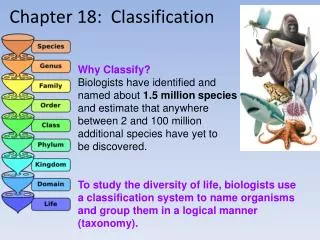
Linnaean Classification System • Uses 7 hierarchical, ordered ranks-taxa • Largest to smallest: Kingdom, phylum, class, order, family, genus, species
Problems with Traditional Classification Used visible similarities/differences (barnacles look like limpets but are more like crabs) Today: use evolutionary relationships Limpet: gastropod mollusk Barnacle: crustacea Crab: Crustacea
18.2 Modern Evolutionary Classification • Evolutionary Classification • Phylogeny: species grouped by evolutionary descent • Common Ancestors: taxa groupings show relationships • Larger, more diverse taxa=more ancient common ancestor • Clades-a monophyletic group: single common ancestor and all descendants (living & extinct)
Cladogram Cladistic analysis shows specific traits branch from comm ancestor Links groups showing evolutionary relationships Building Cladograms: branches (nodes) represent ancestral species splitting in 2 Each node=last point species above line shared com ancestor Root of node=common ancestor of those more recent
Derived Characters: trait arising in most recent ancestor of lineage Losing Traits: tetrapods (4 limbs) include reptiles; snake still reptile Interpreting Cladogram: character positions reflects order they arose Clade vs Traditional grps: evol. links more accurate=clades connects all species back to original ancestor (dinosaurs/ birds/reptile)
DNA in Classfication • Genes as Derived Characteristics • Gene homologies (similarities) determine evolutionryrelationshps • Mutations=derived characteristisc • More recent commn ancestors = ↓ diffs in genes (more mutations in common) =>closer related
African Vulture Amercan Vulture Giant Panda New Evolutionary Trees DNA=more accurate evolutionary tree American vulture looks like African vulture yet DNA & behavior more similar to stork (more recent comm ancestor) Giant panda DNA more like bears; Red panda DNA more like racoons (Pandas now in different clades) Raccoons Red pandas Giant pandas Bears Red Panda Stork Common Ancestor
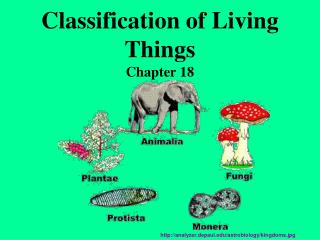
18.3 Kingdoms (6) & Domains(3) • Changing Ideas about Kingdoms • W/diversity of life: science moved from Linnaeus’s 2 kingdms to 5 • Genetic data= bacteria Kingdom Monera divided into 2 • Genome data=new taxonomic division: Domain (larger than kingdom); now have 3 • “Protista”: so diverse, > than 1 commancestr=not true clade
Domain Bacteria • Kingdom Eubacteria • Characteristics: • Unicellular • Prokaryotic • Thick Cell Wall • Peptidoglycan • Diverse (majority)
Domain Archaea • Kingdom Archaebacteria • Characteristics: • Unicellular & anaerobic • Prokaryotic • Cell membranes contain unique lipids • Extreme Env’t
Domain Eukarya w/4 Kingdoms • Kingdom Protista • Paraphyletic group (more than 1 com ancestor) • Plant-like, fungus-like, animal-like members • Now at least 5 clades • Most single celled • Kingdom Fungi • Feed on dead/decaying org. • Cell walls contain chitin • Digest externally • Most multicellular
Kingdom Plantae • Autotrophic=Photosynthesis • Cell Wall (cellulose) • All plants are sister group to red algae (protist) • Kingdom Animalia • Multicellular/hetero • No Cell Wall/Motile