Download
1 / 15
350 likes | 2.39k Views
Adlerian Theory. Alfred Adler. Theory of personality. Consciousness more important than unconsciousness Ego more important than id. The person is viewed holistically— we are creative, responsible, becoming

E N D
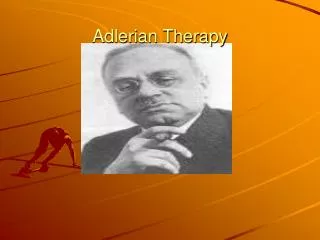
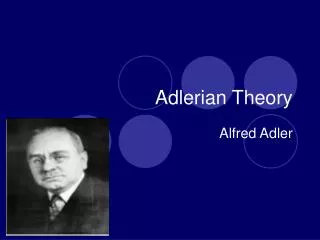
Adlerian Theory Alfred Adler
Theory of personality • Consciousness more important than unconsciousness • Ego more important than id. • The person is viewed holistically— we are creative, responsible, becoming • Contrasts with Freud’s more pessimistic view of human nature and portrayal of personality as comprised of parts • Social being is emphasized • Interpersonal psychology rather than intrapersonal psychology • People are not “pushed” by heredity and environment as much as “pulled” by the future… • The person’s past and circumstances “frame” and “influence” the individual’s goals • Life is a dynamic striving for: • Security • Self-esteem • A place of Significance in the world
Theory of personality • Striving for superiority (Feelings of inferiority) • Born helpless and dependent • Impetus of personality development – The Style of Life • Social Interest • Individual’s attitude toward and awareness of being a part of the human community • Healthy personality related to the degree to which we successfully share with others and are concerned with their welfare • Happiness and success are largely related to social connectedness • Three universal life tasks • Building friendships • Establishing intimacy • Contributing to society • Birth Order • Ordinal position predicts some degree of style of life
The creative self • The concepts involved in the development of the style of life manifest through the CREATIVE SELF • Objective facts translated into personally meaningful events • The creative self drives the individual to negotiate the BASIC LIFE TASKS • Work • Opposite sex relationships • Being a constructive part of society
Inferiority and compensation • As children search for significance, they draw conclusions about the self> • 4 goals of the “discouraged child” • ATTENTION GETTING • POWER SEEKING • REVENGE TAKING • DECLARING DEFICIENCY OR DEFEAT
The discouraged child • All of the 4 goals identified by Dreikurs can be portrayed by any child, discouraged or otherwise. It is a matter of degree, frequency, and whether or not the child has an underlying sense of hopefulness, acceptance and significance that determines the health of the child.
Psychopathology • Two problems drive psychopathology • Exaggerated inferiority feeling • Insufficiently developed feeling of community • Manifest through pathological lifestyles • Pampered lifestyle • Parental overindulgence • Compulsive lifestyle • Parental domination • Other manifestations • Abuse • Neglect
Psychopathology - Basic mistakes • OVERGENERALIZATIONS • FALSE OR IMPOSSIBLE GOALS OF SECURITY • MISPERCEPTIONS OF LIFE AND LIFE’S DEMANDS • MIMIMIZATION OF ONE’S WORTH • FAULTY VALUES Thought: This is a short list but a valuable one; many psychological problems that people have can be explained by these 5 “basic mistakes”.
Goals of Therapy • Educate clients about psychological processes • Educate clients about “basic mistakes” • Release or encourage clients’ social interest • Encourage clients to recognize their equality
Therapeutic Relationship • Prototype of social interest • Love, faith and hope for the human condition • Therapist’s Role • Psychoeducator/role-model • Cooperative • Egalitarian • Authentic, caring, and genuine • Client • Active learner taking social interest within the session
Adlerian Therapeutic Techniques • Analysis • Interpretation geared toward increasing the perception of purposive nature of life • The Life Style Investigation/Feedback • Family constellation • Earliest Recollections • Catching oneself – Contingency control • Acting “As If” – Choosing/reevaluation • Push button technique – Precursor to cognitive interventions. Change through choosing
Content • Intrapersonal conflict important, but marked a distinct move toward dealing with interpersonal conflict • Moved beyond conflict and into meaning and fulfillment
Strengths of Adlerian Therapy • Brief or time-limited • Applicable to community mental health • Addresses social equality issues • Useful for counseling culturally diverse populations • Focus on social context
Limitations • Not very systemized • Which interventions with which patients with which disorders • Is inferiority that important • Difficult to test the idea of creative self or the primacy of social interest • Behavioral explanation is simpler
Other Ego Psychotherapies • More than Adler broke from Freud and focused on the ego as opposed to the Id • Object relations • Interpersonal focus based on mental representations of self and people (objects). • The concept of attachment came for OR theory • TR is more open and warm than traditional psychoanalysis