Download
1 / 29
290 likes | 399 Views
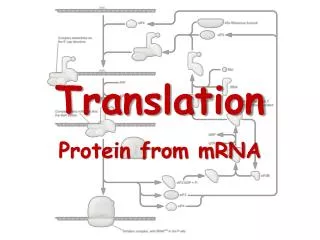
This tutorial explores the complexities of translation initiation in E. coli, focusing on the role of tRNA synthesis and the stringent response mechanism. It highlights how low amino acid availability, indicated by an uncharged tRNA bound to ribosomes, activates a stringent factor that synthesizes ppGpp, regulating rRNA and tRNA transcription. This intricate balance affects gene expression related to amino acid biosynthesis, replication, and carbohydrate synthesis. Key interactions in the ribosomal assembly and the energetics of translation termination are also discussed, providing a comprehensive overview of the translation process.

E N D
Protein structures tutorial Translation Stryer Ch 29 Alberts pp. 331-373 and Ch 12
MVA Fig. 27.19 Assembly of 30S subunit.
ATP Activation! E.coli tRNAgln
rRNA synthesis is affected by nutrition: Low aa availability is signalled by a ribosome bound to an uncharged tRNA. This stimulates a protein called “stringent factor” to catalyze synthesis of the unusual nucleotide ppGpp. This intracellular messenger reduces transcription of rRNA and tRNA genes while upregulating genes involved in aa biosynthesis while repressing genes for replication and carbohydrate synthesis. How does it work? It acts on RNA pol to affect promoter specifity.
Initiation of Translation
Interactions based on x-linking
Interactions based on x-linking
From Science 285: 2095, 1999. CCA end ^ *
Clamp in 30S subunit holding P-site tRNA, and50 S tRNA in P site Codon-anticodon binding A-site tRNA
Opposite views mRNA Grey= 50S, Switch helix= light blue, 30S = purple, A-site tRNA=red
Cognate recoginition
Ribosomal binding sites in the elongation cycle.
Energetics: 4 high energy bonds/aa YOU do the math!!!
Kinetic Proofreading for Selecting Codon-Anticodon Binding
Human globin genes. Red = active, green = pseudogenes, yellow = Kpn sequences