Simplified Triage Guide for Volunteer Responders: Prioritizing Patient Care
This updated guide on triage details the process for determining patient priority in emergencies where victims exceed responder capacity. It outlines four triage categories: 1st priority (critical), 2nd priority (serious), 3rd priority (stable), and 4th priority (obviously dead). Key steps include calling EMS, assessing victims quickly, and employing color-coded tags (red, yellow, green, black) to classify patients based on their conditions. The guide emphasizes rapid assessment and efficient resource allocation to ensure critical care is prioritized effectively.

Simplified Triage Guide for Volunteer Responders: Prioritizing Patient Care
E N D
Presentation Transcript
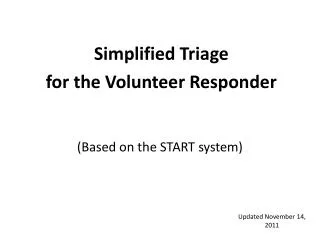
(Based on the START system) Simplified Triage for the Volunteer Responder Updated November 14, 2011
What is Triage? • Triage is a process for determining the priority of patients • This is done in situations were the amount of patients is great than the amount of responders.
Multiple Victims • Decide who needs care and who can wait • Triage systems classify victims into four categories • 1st priority (critical) • 2nd priority (serious) • 3rd priority (stable) • 4th priority (obviously dead)
Triage Process • Call EMS immediately • Ask who can walk and ask them to move to one side (3rd priority) • Assess remaining victims in less than 1 minute • Check for responsiveness, breathing, severe bleeding • Do not start care for anyone until you have checked all • If victim’s condition changes, may have to change priority
Triage Classification • Go in order of this card from top to bottom. • Assess • Treat • Find color • Stop • Tag • Move on
Triage Tags • When determining a patients condition the person is given a colored tag correlating with the state of condition they are in. • We will be treating in the color order Red, Yellow, Green, then Black.
Triage Continuing • After everybody is tagged, begin treating the 1st priority/red patients. • As the 1st priorities start to go away or stabilized then move some recourses to the 2nd priority/yellow patients.
1st Priority Triage (Red) • Victims with life-threatening injuries who cannot wait for help • Airway or breathing problems • Severe bleeding • Shock • Severe burn
2nd Priority Triage (Yellow) • Victims with injuries that need care soon but may be able to wait • Burns • Broken bones • Other injuries that are not severely bleeding
3rd Priority Triage (Green) • Victims who can wait for some time • Minor injuries • Victims who can walk
4th Priority Triage (Black) • Victims who probably can’t be saved • No signs of life