Exploring Invertebrates: The Diverse World of Arthropods and Insect Characteristics
This chapter delves into the fascinating world of invertebrates, specifically focusing on arthropods, which are animals without backbones. It explains the concept of an exoskeleton—an essential protective covering—and discusses various forms of protection that God has provided to insects, such as mimicry and bright colors. The text also covers the processes of metamorphosis, distinguishing between incomplete and complete forms, and highlights social structures like colonies among some insects. Interactive true or false questions enhance understanding of key concepts related to arthropods.

Exploring Invertebrates: The Diverse World of Arthropods and Insect Characteristics
E N D
Presentation Transcript
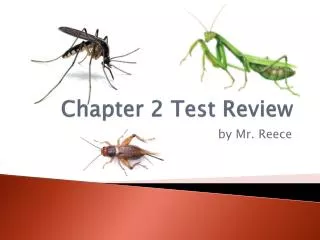
Chapter 2 Test Review by Mr. Reece
Terms Invertebrates • ________________ Animals without backbones • ________________ The hard outside covering of an arthropod • ________________ The largest group of arthropods Exoskeleton Insects
Protection • What are some of the forms of protection that God gave insects? Exoskeleton Stinging Mimicry Biting Bright colors Bad smell Bitter Taste Speed Camouflage
Incomplete Metamorphosis Egg Adult Nymph
Complete Metamorphosis Adult Egg Pupa Larva
Review The knowledge or skills that an animal is born with are called_____________.
Review Insects and spiders are two common kinds of____________.
Review Insects become adults through a change in form called __________________.
Review Some insects, such as ants, live together in a group called a___________.
Review A spiders web is made of _________.
True or False • Hunting and trapping are two ways spiders get food. True
True or False • Arthropods have jointed legs. True
True or False • Spiders eat insects. True
True or False • Both spiders and insects have antennae. False
True or False • All insects have sucking mouthparts. False
True or False • Black widow and brown recluse spiders are poisonous. True