Understanding Ecosystems and Energy: Key Concepts in Ecology and Thermodynamics
230 likes | 363 Views
Chapter 3 provides an overview of ecosystems and the flow of energy through them. It introduces fundamental concepts in ecology, including the first and second laws of thermodynamics, photosynthesis, and cellular respiration. The chapter explores the roles of producers, consumers, and decomposers, and explains the ecological pyramid and ecosystem productivity. It also discusses how energy flows through food chains and webs, emphasizing the importance of energy transfer and loss at each trophic level. Finally, it highlights human impacts on net primary productivity (NPP) in various ecosystems.


Understanding Ecosystems and Energy: Key Concepts in Ecology and Thermodynamics
E N D
Presentation Transcript
Overview of Chapter 3 • Ecology • Energy • First Law of Thermodynamics • Second Law of Thermodynamics • Photosynthesis and Cellular Respiration • Flow of Energy Through Ecosystems • Producers, Consumers & Decomposers • Ecological Pyramid • Ecosystem Productivity
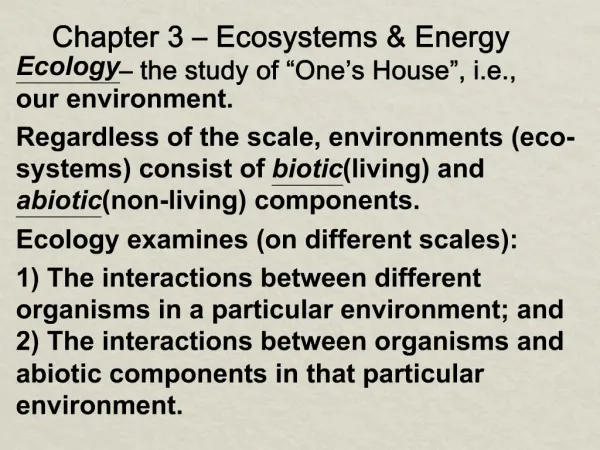
Ecology • Ecology • “eco” house & “logy” study of • The study of interactions among and between organisms in their abiotic environment • Broadest field in biology • Biotic- living environment • Includes all organisms • Abiotic- non living or physical environment • Includes living space, sunlight, soil, precipitation, etc.
Ecology • Biology is very organized • Ecologists are interested in the levels of life above that of organism
Ecology Definitions • Species • A group of similar organisms whose members freely interbreed • Population • A group of organisms of the same species that occupy that live in the same area at the same time • Community • Al the populations of different species that live and interact in the same area at the same time • Ecosystem • A community and its physical (abiotic) environment • Landscape • Several interacting ecosystems
Ecology • Biosphere contains earth’s communities, ecosystems and landscapes, and includes: • Atmosphere- gaseous envelope surrounding earth • Hydrosphere- earth’s supply of water • Lithosphere- soil and rock of the earth’s crust
Energy • The ability or capacity to do work • Chemical, radiant, thermal, mechanical, nuclear, electrical • Energy exists as: • Stored energy (potential energy) • Kinetic energy (energy of motion)
Thermodynamics • Study of energy and its transformations • System- the object being studied • Closed System- Does not exchange energy with surroundings (rare in nature) • Open System- exchanges energy with surroundings
Laws of Thermodynamics • First Law of Thermodynamics • Energy cannot be created or destroyed; it can change from one form to another • Ex: organisms cannot create energy they need to survive- they must capture it from another source • Focus is on quantity • Second Law of Thermodynamics • When energy is converted form one form to another, some of it is degraded to heat • Heat is highly entropic (disorganized) • Focus is on quality
C6H12O6 + 6 H2O + 6 O2 Photosynthesis • Biological process by which energy from the sun (radiant energy) is transformed into chemical energy of sugar molecules • Energy captured by plants via photosynthesis is transferred to the organisms that eat the plants 6 CO2 + 12 H2O + radiant energy
Cellular Respiration • The process where the chemical energy captured in photosynthesis is released within cells of plants and animals • This energy is then used for biological work • Creating new cells, reproduction, movement, etc. C6H12O6 + 6O2 + 6 H2O 6 CO2 + 12 H2O + energy
Energy Flow • Passage of energy in a one-way direction through an ecosystem • Producers • Primary consumers • Secondary consumers • Decomposers
Food Chains- The Path of Energy Flow • Energy from food passes from one organisms to another • Each “link” is called a trophic level
Food webs represent interlocking food chains that connect all organisms in an ecosystem
Ecological Pyramids • Graphically represent the relative energy value of each trophic level • Important feature is that large amount of energy are lost between trophic levels to heat • Three main types • Pyramid of numbers • Pyramid of biomass • Pyramid of energy
Pyramid of Numbers • Illustrates the number of organisms at each trophic level • Usually, organisms at the base of the pyramid are more numerous • Fewer organisms occupy each successive level • Do not indicate the biomass of the organisms at each level or the amount of energy transferred between levels
Pyramid of Biomass • Illustrates the total biomass at each successive trophic level • Biomass: measure of the total amt of living material • Biomass indicates the amount of fixed energy at a given time • Illustrates a progressive reduction in biomass through trophic levels
Pyramid of Energy • Illustrates how much energy is present at each trophic level and how much is transferred to the next level • Most energy dissipates between trophic levels • Explains why there are so few trophic levels • Energy levels get too low to support life
Ecosystem Productivity • Gross Primary Productivity (GPP) • Total amount of energy that plants capture and assimilate in a given period of time • Net Primary Productivity (NPP) • Plant growth per unit area per time • Represents the rate at which organic material is actually incorporated into the plant tissue for growth • GPP – cellular respiration = NPP • Only NPP is available as food to organisms
Human Impact on NPP • Humans consume more of earth’s resources that any other animal • Humans represent 0.5% of land-based biomass • Humans use 32% of land-based NPP! • This may contribute to loss of species (extinction) • Humans’ high consumption represents a threat to planet’s ability to support both human and non-human inhabitants