Energy Transfer
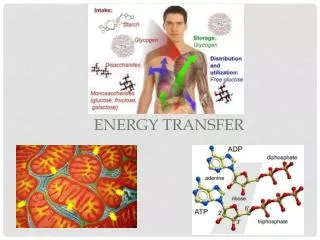
Energy Transfer. Adenosine Triphosphate The Energy Currency. The energy in food does not transfer directly to the cells for biologic work. Rather, energy from macronutrient oxidation is harvested and funneled through ATP.

Energy Transfer
E N D
Presentation Transcript
Adenosine TriphosphateThe Energy Currency • The energy in food does not transfer directly to the cells for biologic work. Rather, energy from macronutrient oxidation is harvested and funneled through ATP. • The energy donor - energy receiver role of ATP represents the body’s two main energy transforming activities. • Extract potential energy from food and conserve it within the bonds of ATP. • Extract and transfer the chemical energy in ATP to power biologic work.
A Limited Currency • Cells store only a small quantity of ATP and must therefore continually resynthesize it at its rate of use. • ATP is a relatively heavy molecule and the average sedentary person resynthesizes enough ATP in one day to equal ~ 75% their body weight. • The body stores ~ 80-100 g of ATP at any time. • Costs about 80 kg of ATP to run a marathon in 2.5 hrs.
Harnessing ATP’s Potential Energy • ATP hydrolysis: • ATP + H2O ATPase ADP + Pi = 7.3 kcal/mol • ATP Resynthesis: • PCr + ADP creatine kinase Cr ATP • 2 ADP adenylate kinase ATP + AMP
ATP Resynthesis • Cells are very sensitive to a decrease in the ATP:ADP ratio. • Signal the enzymes involved in ATP resynthesis to kick in. • Phosphocreatine (PCr) – The energy reservoir. • Anaerobic resynthesis of ATP from ADP • Creatine can later be phosphorylated back to PCr • Cells store ~ 4-6 times more PCr than ATP
Important By-Products • ATP hydrolysis and resynthesis generate as by-products: • Pi • AMP • ADP • These by-products stimulate: • Glycogenolysis • Glycolysis • Respiratory pathways of mitochondria
Cellular Oxidation • There is not enough stored ATP to fuel all of your body’s processes. • Your body must oxidize stored macronutrients so that mitochondria can synthesize more ATP. • ATP is synthesized by coupling of electron transport and oxidative phosphorylation in the electron transport chain.
Energy Release From Food • Macronutrient catabolism serves one crucial purpose – to phosphorylate ADP to re-form ATP. • 3 broad stages: • Digestion, absorption, and assimilation of relatively large food macromolecules into small subunits. • Within the cytosol, AA’s, glucose, fatty acids, and glycerol units are degraded into acetyl-CoA • Within the mitochondria, acetyl-CoA degrades to CO2 and H2O with considerable ATP resynthesis.
Citric Acid Cycle • AKA Krebs cycle, tricarboxylic acid cycle. • A complex sequence of metabolic events that degrades acetyl-CoA to carbon dioxide and hydrogen atoms. • The hydrogen atoms are then oxidized during the electron transport chain.
Electron Transport Chain • Iron-rich carrier molecules transport electrons via redox reactions. • Oxygen is the final electron acceptor. • This process is responsible for > 90% of ATP synthesis. NADH + H+ + 3 ADP + 3 Pi + ½ O2 = NAD+ + H20 + 3 ATP
Energy Transfer From Food • Liver releases glucose and deaminated amino acids into the bloodstream. • Adipose tissue releases fatty acids into the bloodstream. • Within the cytosol, glucose, AA’s and fatty acids get turned into acetyl-CoA. • Acetyl-CoA enters the citric acid cycle and produces NADH and H+ ions. • Hydrogen ions enter the ETC and resynthesize ADP into ATP.