Download
1 / 12
130 likes | 260 Views
Soil is a loose covering of weathered rock and decaying organic matter, critical for plant growth. It forms over thousands of years, involving processes of chemical and mechanical weathering. Key layers of soil include organic matter, weathered rock, residual soil, and bedrock. Groundwater is vital, with most of Earth's fresh water stored as polar ice or in the ground. The water table indicates where groundwater fills pore spaces in soil, which affects its movement. Aquifers allow groundwater to flow, while aquicludes can act as barriers.

E N D
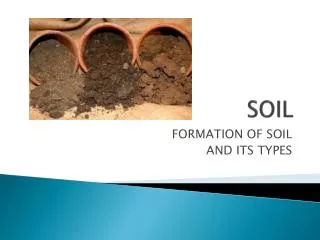
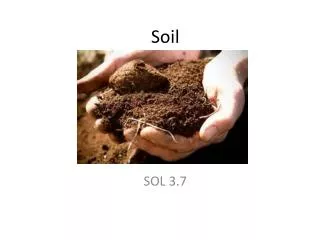
Soil Formation • What is soil? • a loose covering of weathered rock particles decaying organic matter, called HUMUS, overlying the bedrock of Earth’s surface, and serves as a medium for the growth of plants Soil is the product of thousands of years of chemical and mechanical weathering
Soil Development • Weathering breaks down solid bedrock into smaller pieces • These pieces undergo continuous weathering and breakdown into smaller pieces • Worms and other organisms help breakdown organic matter and add nutrients to the soil as well as creating passages of air for water to enter.
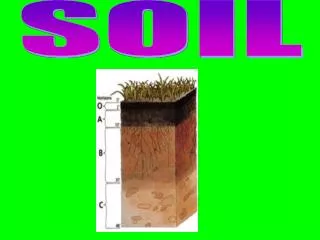
Soil Layers • (O) Organic matter (A) Weathered rock • (B) Residual Soil • (C)Bedrock
Soil Layers • Organic Matter: Made of Leaf Litter and Humus • Weathered Rock: combined with rich dark brown organic matter • Residual Soil: enriched over time by clay and minerals deposited by the water above • Bedrock (parent Soil): little to no organic matter; oldest layer
The Hydrosphere: water on and in Earth’s crust • 97% contained in the oceans • 3% of this water contained by landmasses (nearly all freshwater) • More than 90% of freshwater on Earth in the form of polar ice caps and glaciers • Remaining freshwater is groundwater • Rivers, streams, lakes only small portion of Earth’s freshwater
Precipitation and Groundwater • Evaporation of ocean waters, forms clouds/precipitation, weather systems and winds move this moisture build up all over Earth • Falls to land and enters ground through infiltration, becoming groundwater • Groundwatermove through ground, returns to surface via springs, then flows back to oceans.
Groundwater Storage: Where does the water go? • Soils consist of particles and pores. These pores can be filled with air but also with water. The amount of pores in soil is different for different types of soil. • Zone of Saturation: depth below Earth’s surface at which groundwater completely fills all the pores of a material • Upper boundary of this zone= water table • Only the water in the zone of saturation is called groundwater
The Water Table • Depth varies with local conditions • Water table fluctuates with season and weather conditions because of its dependence on precipitation
Groundwater Movement • Flows downhill in direction of slope of the water table • Moves extremely slow because the water has to travel through numerous tiny pores • Ability of material to let water pass= permeability • Large connected pores= high permeability (sand and gravel) • Silt and clay=tiny pores=impermeable
Aquifers Most groundwater flows through permeable layers known as aquifers Aquicludes: barriers to groundwater flow