Understanding Optimality Modeling in Animal Behavior: Insights into Decision-Making Strategies
Optimality modeling is a crucial tool for analyzing the decision-making behaviors of animals, revealing how they maximize their inclusive fitness in various circumstances. Key aspects include identifying decision alternatives, determining what parameters are being maximized (currency), and recognizing the constraints faced. This approach addresses challenges like optimal foraging, patch choice, and time allocation, highlighting both the benefits of sociality—such as resource sharing and mate locating—and the inherent costs like increased competition and disease risk. This comprehensive understanding aids in appreciating the complexities of animal behavior.

Understanding Optimality Modeling in Animal Behavior: Insights into Decision-Making Strategies
E N D
Presentation Transcript
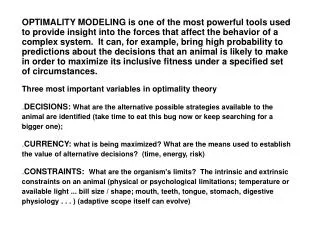
OPTIMALITY MODELING is one of the most powerful tools used to provide insight into the forces that affect the behavior of a complex system. It can, for example, bring high probability to predictions about the decisions that an animal is likely to make in order to maximize its inclusive fitness under a specified set of circumstances. Three most important variables in optimality theory .DECISIONS: What are the alternative possible strategies available to the animal are identified (take time to eat this bug now or keep searching for a bigger one); .CURRENCY: what is being maximized? What are the means used to establish the value of alternative decisions? (time, energy, risk) .CONSTRAINTS: What are the organism's limits? The intrinsic and extrinsic constraints on an animal (physical or psychological limitations; temperature or available light ... bill size / shape; mouth, teeth, tongue, stomach, digestive physiology . . . ) (adaptive scope itself can evolve)
OPTIMALITY Artists don’t get down to work until the pain of working is exceeded by the pain of not working (Stephen DeStaebler) If you bring forth that which is within you, what you bring forth will save you. If you do not bring forth that which is within you, what you do not bring forth will destroy you. (Gospel of St Thomas)
OPTIMAL FORAGING • Examples of problems that can be addressed: • choice by an animal of which food types to eat (i.e., optimal diet); • choice of which patch type to feed in (i.e., optimal patch choice); • optimal allocation of time to different patches; and • optimal patterns and speed of movements.
BENEFITS of SOCIALITY • 1. protection from environmental extremes (energetic efficiency) • 2. antipredator (confusion effects; mobbing and group defense; alarm calling) • 3. feeding efficiency (information sharing; increased competitive ability) • 4. population stability • 5. division of labor (thereby allowing for various and potentially adaptive innovations: recombinations of the ways in which the labor was divided; predisposes to specialization and caste development) • 6. Mate location efficiency • 7. Resource defense • 8. Information exchange (including a richer learning environment for young)
COSTS of SOCIALITY • 1. increased competition for resources, mates • 2. increased rates of parasitism and disease • 3. increased conspicuousness to predators • 4. risk of inbreeding • 5. risk of misdirected parental care • 6. risk to offspring from conspecifics
And then the day came when the risk to remain tight in a bud was more painful than the risk it took to blossom. -- Anaïs Nin