Download
1 / 21
210 likes | 310 Views
The Americans with Disabilities Act (ADA) is crucial for ensuring accessibility and preventing discrimination in various programs, including camps. This session presented by Jennifer K. Skulski from the National Center on Accessibility covers essential updates under Titles I, II, and III of the ADA. Directors will learn about key principles, definitions of disability, recent regulations, and best practices for compliance, focusing on providing inclusive environments for all campers. Make sure your camp meets the new standards for facilities and services as outlined in the ADA.

E N D
Americans with Disabilities Act Status UpdateWhat All Camp Directors Need to Know Presented byJennifer K. SkulskiNational Center on Accessibilitywww.ncaonline.org jskulski@indiana.edu
RefresherAmericans with Disabilities Act • Title I – Employment • Title II – State & Local Government • Example: Day camp run by municipal park & recreation department • Title III – Public Accommodations • Example: Week long overnight camp coordinated by YMCA branch
Purpose of ADA • Eliminate discrimination • Employment • Public Services • Transportation • Public Accommodations • …… and more • Expand integration
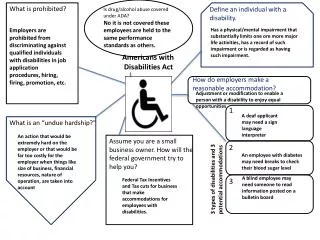
Americans with Disabilities Act Prohibits discrimination on the basis of disability against qualified individuals with disabilities.
Definition of a Disability • A physical or mental impairment that substantially limits one or more major life activities; • A record of such an impairment; or • Regarded as having such an impairment.
Key Principles of the ADA • Most integrated setting; • When viewed in its entirety; • Modification of policies, practices and procedures; • Effective communication; • Removal of physical or communication barriers to programs, activities, goods or services.
Defenses • Direct threat • Fundamental alteration to the nature of the program • Undue hardship
Revised ADA Regulations (2010) • Nondiscrimination policies • 2010 Standards • New construction • Alterations • Additional design requirements • Existing facilities
Important Dates • General effective date • March 15, 2011 • Compliance date for 2010 Standards • March 15, 2012 • The 2010 Standards must be followed for new construction, alterations, barrier removal and program access.
Nondiscrimination PoliciesTitle II & Title III Regulations • Service animals • A dog that has been individually trained to do work or perform tasks for the benefit of an individual with a disability. • Animals used for emotional support are not covered. • Wheelchairs and other power-driven mobility devices • Wheelchairs must be permitted in all areas of pedestrian use. • Other devices can be limited based on fundamental alteration to the nature of the program or direct threat.
Existing Facilities • Title II • Program Access • Title III • Readily Achievable Barrier Removal • Safe Harbor • Safe to use 1991 in interim of compliance date • Does NOT apply to elements in existing facilities that were not subject to 1991 standards (i.e. Chapter 10 Recreation Facilities)
2010 StandardsCommon Elements at Camp • Boating facilities • Fishing facilities • Swimming pools • Sports courts • Play areas
ScopingAccessible Routes • Bowling lanes (5%) • Shooting facilities (5%) • Sports courts (connects both sides of court) • Exercise equipment • Amusement rides
Chapter 10: Recreation FacilitiesBoating Facilities • Accessible route to boat slips • Boarding piers
Chapter 10: Recreation FacilitiesFishing Piers & Platforms • Accessible routes • Dispersion • Railing height & edge protection • Clear floor space
Chapter 10: Recreation FacilitiesPlay Areas • Accessible route at entry and at access/egress to accessible components • Ground level components • Transfer or ramp to elevated components • Surfacing
Chapter 10: Recreation FacilitiesSwimming Pools, Wading Pools & Spas • At least 2 accessible means of entry* • Pool lift** • Sloped entry** • Transfer system • Pool stairs * Exception allows for one means of entry at pools less than 300 linear ft. **At least one means of entry shall be a pool lift or sloped entry
Upcoming Rulemaking • Outdoor Developed Areas • Trails • Campgrounds • Picnic Areas • Beaches • Draft Final Guidelines (U.S. Access Board, Oct 2009) http://www.access-board.gov/outdoor/draft-final.htm
Action Planning • Accessibility Coordinator • Access Team • Accessibility Assessment of Facilities • Self Evaluation of Policies & Procedures • Transition Plan
Online Resources • www.ncaonline.orgweb modules on program access, universal design • Discover Camp www.indiana.edu/~nca/discover/ • Discover Leisure www.indiana.edu/~nca/leisureed/ • Universal Challenge Courses www.indiana.edu/~nca/challenge/ • www.accessibilityonline.orgmonthly webinar with Access Board • www.ada-audio.orgaudio conferences, webinars hosted by the regional ADA Centers
Resources • National Center on Accessibility • www.ncaonline.org • (812) 856-4422 voice • (812) 856-4421 tty • U.S. Department of Justice • www.ada.gov • (800) 514-0301 • Equal Employment Opportunity Commission • www.eeoc.gov • (800) 669-4000 • U.S. Access Board • www.access-board.gov • (800) 872-2253 • Regional ADA Centers • www.adata.org • (800) 949-4232