Understanding Big-O Performance Analysis: Key Factors and Growth Rates
This presentation by Dr. Simon Garrett from the University of Wales, Aberystwyth, delves into Big-O performance analysis, emphasizing its role in characterizing algorithm efficiency. It explores key execution time factors including CPU speed, memory, compiler efficiency, data size, and algorithm choice. Viewers will learn how to determine Big-O notation by examining code structures involving repetition, selection, and sequence. The talk highlights the importance of selecting the right algorithm for varying data sizes and presents common growth rates like O(log N), O(N), and O(N²) in practical scenarios.

Understanding Big-O Performance Analysis: Key Factors and Growth Rates
E N D
Presentation Transcript
Big-O Performance Analysis Based on a presentation by Dr. Simon Garrett, The University of Wales, Aberystwyth: http://users.aber.ac.uk/smg/Modules/CO21120-April-2003/NOTES/15-Complexity.ppt
Execution Time Factors • Computer: • CPU speed, amount of memory, etc. • Compiler: • Efficiency of code generation. • Data: • Number of items to be processed. • Initial ordering (e.g., random, sorted, reversed) • Algorithm: • E.g., linear vs. binary search.
Are Algorithms Important? • The fastest algorithm for 100 items may not be the fastest for 10,000 items! • Algorithm choice is more important than any other factor! O(log N) O(N) O(N2)
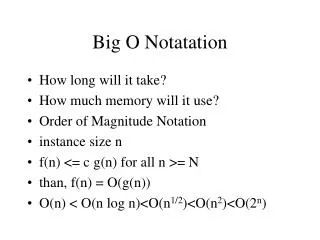
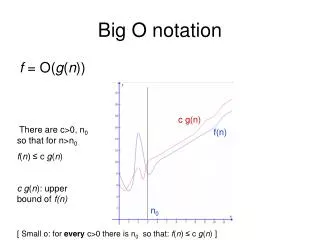
What is Big-O? • Big-O characterizes algorithm performance. • Big-O describes how execution time grows as the number of data items increase. • Big-O is a function with parameter N, where N represents the number of items.
Predicting Execution Time • If a program takes 10ms to process one item, how long will it take for 1000 items? • (time for 1 item) x (Big-O( ) time complexity of N items)
How to Determine Big-O? • Repetition • Sequence • Selection • Logarithmic
executed n times constant time Determining Big-O: Repetition for (i = 1; i <= n; i++) { m = m + 2 ; } Total time = (a constant c) * n = cn = O(N) Ignore multiplicative constants (e.g., “c”).
outer loop executed n times inner loop executed n times constant time Determining Big-O: Repetition for (i = 1; i <= n; i++) { for (j = 1; j <= n; j++) { k = k+1 ; } } Total time = c * n * n * = cn2 = O(N2)
outer loop executed n times inner loop executed 100 times constant time Determining Big-O: Repetition for (i = 1; i <= n; i++) { for (j = 1; j <= 100; j++) { k = k+1 ; } } Total time = c * 100 * n * = 100cn = O(N)
Determining Big-O: Sequence constant time (c0) x = x +1; for (i=1; i<=n; i++) { m = m + 2; } for (i=1; i<=n; i++) { for (j=1; j<=n; j++) { k = k+1; } } executed n times constant time (c1) outer loop executed n times inner loop executed n times constant time (c2) Total time = Total time = c0 Total time = c0 + c1n Total time = c0 + c1n + c2n2 Total time = c0 + c1n + c2n2 = O(N2) Only dominant term is used
then part: constant (c1) else part: (c2 + c3) * n Determining Big-O: Selectiontest + worst-case(then, else) test: constant (c0) if (depth( ) != otherStack.depth( ) ) { return false; } else { for (int n = 0; n < depth( ); n++) { if (!list[n].equals(otherStack.list[n])) return false; } } another if : test (c2) + then (c3) Total time = c0 Total time = c0 + Worst-Case(then, else) Total time = c0 + Worst-Case(c1, else) Total time = c0 + Worst-Case(c1, (c2 + c3) * n) = O(N)
Determining Big-O: Logarithmic An algorithm is O(log N) if it takes a constant time to cut the problem size by a fraction (usually by ½) Example: Dictionary (binary) search • Look at middle of the dictionary • Is word before or after? • Repeat with left or right half until found