
Mastering English Contractions: A Quick Guide
Contractions in English are formed by omitting letters, often combining pronouns with verbs or negations. This guide explores common contractions like "she’s," "you’re," "don’t," and "won’t." Enhance your writing by learning how to convert full sentences into their contracted forms. For instance, "Jake is the loveliest guy I ever met" becomes "Jake’s the loveliest guy I ever met." Practice transforming sentences like "I will not go to the party unless you come with me" to "I won’t go to the party unless you come with me" and more, improving your fluency and style.

Mastering English Contractions: A Quick Guide
E N D
Presentation Transcript
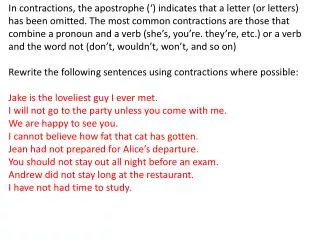
In contractions, the apostrophe (‘) indicates that a letter (or letters) has been omitted. The most common contractions are those that combine a pronoun and a verb (she’s, you’re. they’re, etc.) or a verb and the word not (don’t, wouldn’t, won’t, and so on) Rewrite the following sentences using contractions where possible: Jake is the loveliest guy I ever met. I will not go to the party unless you come with me. We are happy to see you. I cannot believe how fat that cat has gotten. Jean had not prepared for Alice’s departure. You should not stay out all night before an exam. Andrew did not stay long at the restaurant. I have not had time to study.
