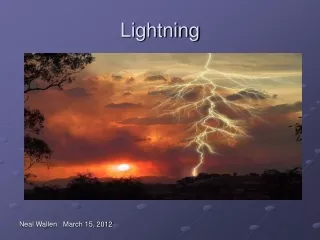
Lightning
Explore the fascinating world of lightning composition and electric discharge lamps. Comprising 78% nitrogen, 21% oxygen, and 1% argon, the atmosphere also contains trace components like carbon dioxide, krypton, and more. Electric discharge lamps, like fluorescent lightbulbs, utilize electric current to excite gas atoms, emitting electromagnetic radiation, primarily visible light, along with some UV rays. Discover how various gases like mercury, argon, and oxygen contribute to different colors of light in lamps. Learn about their practical applications in lighting technology.

Lightning
E N D
Presentation Transcript
For Your Enjoyment Lightning
Composition • Main components • 78% Nitrogen • 21% Oxygen • 1% Argon • Trace components • Carbon dio/monoxide • Krypton • Hydrogen • Helium • Nitrous oxide • Neon • Methane • Ozone • Iodine • Nitrogen Dioxide • Ammonia
Gas Discharge Lamps • Common example: fluorescent lightbulbs • Electric current travels through a tube • The travelling electrons excite the electrons in the gas atoms/molecules. When the electrons move back to lower state, they emit EMR. • EMR is usually in the visible light area but sometimes UV rays are emitted.
Mercury • Mercury emits a bright light. • Light blue • RGB combine to form mostly white light. • Commonly used • Esp. with argon
Nitrogen • Similar to Argon, but duller and more pink. • Argon is violet to pale lavender blue. • Becomes bright blue-white at high peak currents.
Oxygen • Violet to lavender • Dimmer than argon
Argon • Violet to pale Lavender blue. • Often used together with mercury in lamps.
Carbon Dioxide • Bright-white • Brighter than Xenon in lower currents • Xenon is used in car headlights. • Impressive!