DNA Structure and Nucleotides: Watson, Crick, Franklin, and Wilkins Discoveries
210 likes | 338 Views
Exploring the 1953 breakthrough by Watson, Crick, Franklin, and Wilkins in DNA structure elucidation, including DNA forms, nucleotide composition, base pairing, replication, and different structural types.


DNA Structure and Nucleotides: Watson, Crick, Franklin, and Wilkins Discoveries
E N D
Presentation Transcript
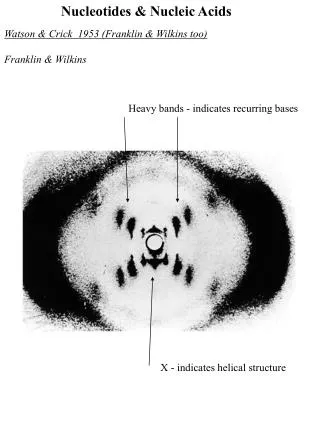
Nucleotides & Nucleic Acids Watson & Crick 1953 (Franklin & Wilkins too) Franklin & Wilkins Heavy bands - indicates recurring bases X - indicates helical structure
Nucleotides & Nucleic Acids Watson & Crick 1953 (Franklin & Wilkins too) Watson & Crick Used x-ray crystallography data Used Chargaff’s rules 3D structure of DNA, strands antiparallel
Nucleotides & Nucleic Acids DNA structure Complementarity Strands not identical in base sequence or composition DNA replication
Nucleotides & Nucleic Acids DNA structure - different forms
A-DNA B-DNA Z-DNA
Nucleotides & Nucleic Acids DNA structure - different forms Structure type A B Z Axial rise (h) per nt (Å) 2.56 3.38 3.7 Groove width (Å) minor major 11 2.7 5.7 11.7 8.8 2 Groove depth (Å) minor major 2.8 13.5 7.5 8.5 3.7 13.8 Pitch (Å) 28.2 33.8 45 Z-DNA virtually no major groove due to syn-G, pulls C into major grv Pitch = axial rise x repeat (bp/turn) distance for complete turn of helix So for A-DNA 2.56 Å x 11 bp/turn = 28.2 Å axial rise (h) distance between bp
purine rotated into major groove
A-DNA B-DNA A-DNA + bulge 32˚ tilted upward
Triple Helix Intrastrand base pairing
Triple Helix using a third strand of DNA Interstrand base pairing Restriction endonuclease