Download
1 / 7
70 likes | 190 Views
This study investigates the flow field parameters for the Gulfstream I aerosol inlet, comparing experimental data with model-derived outcomes. Conducted during a field experiment on July 9, 2002, in Worcester, MA, the research aimed to determine if the experimental parameters, such as flow separation and turbulence characteristics, align with computational results from a 2D axisymmetric model using GAMBIT and FLUENT software. Key instrumentation included four hot wire anemometers to measure the airflow under specified conditions, contributing to the understanding of aerosol dynamics in aviation contexts.

E N D
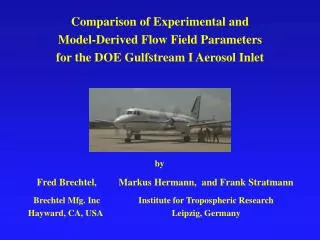
Comparison of Experimental and Model-Derived Flow Field Parameters for the DOE Gulfstream I Aerosol Inlet by Fred Brechtel,Markus Hermann, and Frank Stratmann Brechtel Mfg. Inc Institute for Tropospheric Research Hayward, CA, USA Leipzig, Germany
3 4 1 2 Experimental Parameters • aircraft: Gulfstream I, DOE • inlet: two-stage diffuser aerosol inlet with 5° half angle • field experiment: July 9, 2002, Worcester, MA 500-1000 m, 100-115 m/s, 0.3 M, 977 hPa, 297 K • instrumentation: 4x hot wire anemometers (Dantec Dynamics, Model 55P16)
Model Parameters • goal: - flow field in and around the inlet - do experimental and model-derived flow parameters agree? - does the flow separate? • software: GAMBIT 2.0, FLUENT 6.0 • model: 2d, axisymmetric, 135,000 grid cells • turbulence: k--RNG, enhanced wall treatment • input parameters: 977 hPa, 297 K, 106 m/s, 0.3 M
3 1 4 2 Velocity Along Axis
3 1 4 2 Turbulence Intensity Along Axis