Understanding the Naming of Binary Ionic Compounds and Polyatomic Ions
This guide provides a comprehensive overview of how to name binary ionic compounds, polyatomic ions, and those containing transition metals. It explains the systematic approach to naming these compounds: cations are named first, followed by anions with their endings modified to -ide. For transition metals, Roman numerals indicate their charge. Additionally, it details common anion names, key polyatomic ions, and how to derive chemical formulas from compound names, ensuring clarity in understanding ionic compound nomenclature.

Understanding the Naming of Binary Ionic Compounds and Polyatomic Ions
E N D
Presentation Transcript
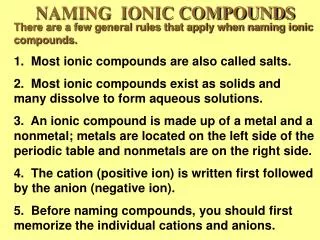
Naming Binary Ionic Compounds • Binary ionic compounds contain only 2 types of elements. CaCl2 1. Name cation first. Cation name is the name of the element. • Ca2+ = calciumion 2. Name anion second. Anion name is the name of the element with ending changed to –ide. Anion = root + -ide Chlorine = Chloride 3. Combine names. The cation is always listed 1st. CaCl2= calcium chloride
Common Anion Names • Fluorine • Fluoride • Chlorine • Chloride • Bromine • Bromide • Iodine • Iodide • Oxygen • Oxide • Sulfur • Sulfide • Nitrogen • Nitride • Phosphorus • Phosphide
Naming Ionic Compounds With Transition Metals • Use Roman numeralto representcharge in name. Determine charge based on TOTAL charge of anions. • NOTE: If metal is not aluminum or a group 1 or 2 element, it must have a Roman numeral. • PbCl2 • Pb2+is cation • PbCl2 = lead (II) chloride
Naming Ionic Compounds with Polyatomic Ions • Use regular name of polyatomic ion. • Mg3(PO4)2 • PO43-is phosphate • Mg3(PO4)2 = magnesium phosphate
Common Polyatomic Ions • Ammonium • NH4+ • Chlorate • ClO3- • Hydroxide • OH- • Cyanide • CN- • Acetate • C2H3O2- • Sulfate • SO42- • Carbonate • CO32- • Phosphate • PO43-
Determining Formula from Name Iron (III) Carbonate • 1. Write formula of cation. • If cation is a transition metal, use Roman numeral to determine charge. • Fe3+ • 2. Write formula of anion. • CO32- • 3. Criss-cross charges to determine formula. • Fe2(CO3)3