ELECTRIC CHARGE
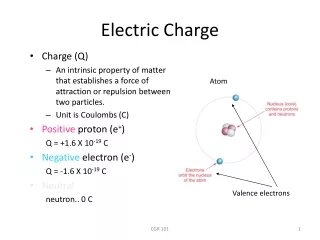
ELECTRIC CHARGE. property of matter that creates electric and magnetic forces and interactions. depends on the imbalance of its protons and electrons. Electrons negatively charged protons positively charged neutrons are neutral (no charge). ELECTRIC CHARGE.

ELECTRIC CHARGE
E N D
Presentation Transcript
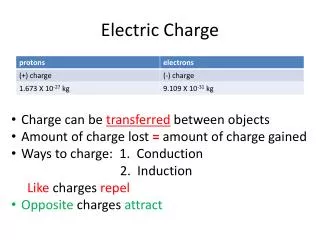
ELECTRIC CHARGE • property of matter that creates electric and magnetic forces and interactions. • depends on the imbalance of its protons and electrons. Electrons • negatively charged protons • positively charged neutrons • are neutral (no charge).
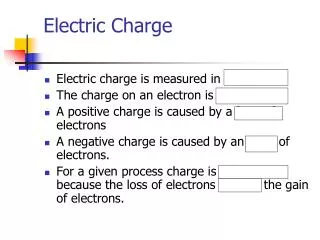
ELECTRIC CHARGE • Negatively charged objects have more electrons than protons. • Positively charged objects have fewer electrons than protons. SI unit: • coulomb, C.
LAW OF CHARGES • Like charges repel • opposite charges attract.
ELECTRIC CHARGE ELECTRICAL CONDUCTOR: • material in which charges can move freely and that can carry an electric current. ELECTRICAL INSULATOR: • material that does not transfer current easily.
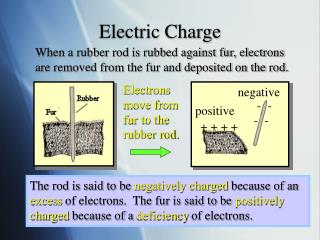
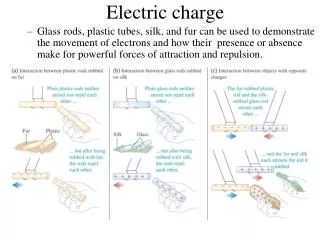
CHARGING BY FRICTION • When an object whose electrons are loosely held rubs against another object, electrons are transferred to the second object .
INDUCED CHARGES • Electrons are moved to opposite ends (not by contact) polarization • Alignment of charges at surface of an object producing an electric charge • Positive & negative charges on opposite sides
CHARGING BY CONTACT • charge a neutral object by touching it with a charged object. The transfer of electrons to the metal doorknob gives the doorknob a net negative charge. When a negative rod touches a neutral doorknob, electrons move from the rod to the doorknob.
STATIC DISCHARGE • movement of electrons to relieve a separation in charge
ELECTRIC FORCE • force of attraction or repulsion between objects due to charge. Electric force depends on charge and distance. • proportional to product of charges on objects. • inversely proportional to square of distance between two objects.
ELECTRIC FIELD LINES • point in direction of electric force on a positive charge. • positive charge point outward. • negative charge point inward. • never cross one another. • show both direction of an electric field and relative strength due to a given charge. • More lines are drawn for greater charges to indicate greater force.