Download
1 / 34
350 likes | 459 Views
This report outlines the background, various models, recent works, and a new approach to understanding the braking indexes of isolated pulsars. It covers the braking law, magnetic dipole model assumptions, observations from notable works, and recent research studies focusing on magnetic field evolution and braking law models. Recent observations, including those from arXiv articles, shed light on theories like disk-assisted spin-down and magnetic field evolution scenarios. The work also delves into pulsar characteristics and specific cases like PSR J1734-3333's unique radio pulsations.

E N D
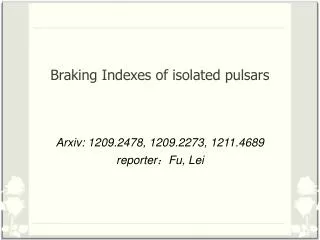
Braking Indexes of isolated pulsars Arxiv: 1209.2478, 1209.2273, 1211.4689 reporter:Fu, Lei
Outline • 1.Background • 2.Models • 3.Recent works • 4.Our work
Theories Background Braking law • magnetic dipole model Assume:1.pure magnetic dipole model2.constant magnetic field
Observations Background • Lyne et al.(1993) • Crab B0531+21: n=2.51 • Kaspi et al.(1994) • B1509-58 : n=2.91 • Lyne et al.(1996) • Vela B0833-45 : n=1.4
models Magnetic field evolution magnetic diople radiation: B≠constant Braking law
models Disk assisted spin down • oblique rotator, non-dipole field, pulsar wind, quadrapole gravitational radiation, varying of effective moment of inertia……
Observations recent works
arxiv:1209.2478 recent works • S.-N. Zhang & Y. Xie 2012 ApJ, 757,153 • magnetic evolution
arxiv:1209.2478 recent works for young pulsars for old pulsars
Observations recent works baby pulsars
for baby pulsar younger than 2000 yr recent works • for Crab pulsar: age=957 yr(AD1054) • this model only applicable for young and old pulsars
Observations recent works
arxiv:1209.2273 recent works • J.A. Pons, D. Viganò & U. Geppert 2012 A&A 547,9 • Magnetic field evolution senarios fallback burying reemergence SN thermoelectric field generation Hall drift Ohmic decay
recent works • Thermoelectric field generation • only efficient for • <1000 yr (in standard cooling senario) • Field reemergence • accreted mass • Ohmic decay • timescale • σ depends on • dominant in and lead n> 3 • after neutrino->photon cooling(105 yr) is slow
recent works • Hall drift oscillatory modes • timescale • significant for large B field • dipole field->smaller scale • toroidal field->dipole field
recent works Hall drift oscillatory modes
recent works P0=0.01s8 pulsars2.5 kyr
recent works arXiv:1211.4689Ş. Çalişkan, U. Ertan, M. A. Alpar et al.(2012) • PSR J1734-3333 • only pulsation at radio band
recent works Disk assisted spin-down