Comprehensive Guide to Latin Noun and Adjective Case Endings
60 likes | 185 Views
Explore the fundamental case endings for Latin nouns and adjectives across all five declensions. This guide details the forms for each case, including nominative, genitive, dative, accusative, and ablative, in singular and plural. Learn how to identify and use nouns, and adjectives in their respective cases, focusing on examples from first, second, third, fourth, and fifth declensions. Understand the distinctions between masculine, feminine, and neuter forms, enhancing your Latin language skills for better comprehension and usage.


Comprehensive Guide to Latin Noun and Adjective Case Endings
E N D
Presentation Transcript
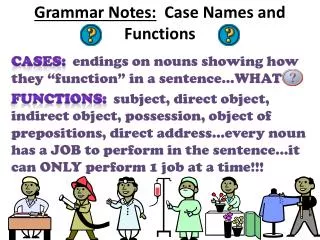
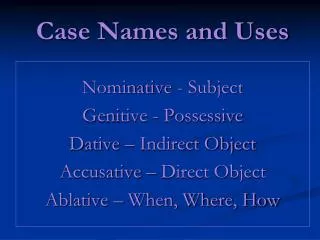
Case Names and Uses Nominative - Subject Genitive - Possessive Dative – Indirect Object Accusative – Direct Object Ablative – When, Where, How
Nouns/Adjectives – Case Endings 1st declension – feminine (except for “real men”) singular plural Nom. -a -ae Gen. -ae -ārum Dat. -ae -īs Acc. -am -ās Abl. -ā -īs
Nouns/Adjectives – Case Endings 2nd declension - (-us/-er = masc. //-um = neut.) singularplural Nom.-us/-er//-um -ī//-a Gen.-ī -ōrum Dat.-ō -īs Acc.-um -ōs//-a Abl.-ō -īs
Nouns/Adjectives – Case Endings 3rd declension - (all three genders possible) singular plural Nom. -is/-es/-or/-tas, etc. -ēs/-a/-ia Gen. -is -um/-ium Dat. -ī -ibus Acc. -em//=nom. -ēs/-a/-ia Abl. -e -ibus
4th declension - (-us =masc. //-ū = neut.) singular Nom. -us//-ū Gen. -ūs Dat. -ui Acc. -um//-ū Abl. -ū plural -ūs//-ua -uum -ibus -ūs//-ua -ibus Nouns – Case Endings
5th declension (fem. ex. diēs = masc./but special days = fem.) singular Nom. -ēs Gen. -ēi Dat. -ēi Acc. -em Abl. -ē plural -ēs -ērum -ēbus -ēs -ēbus Nouns – Case Endings