Discovering Peru: A Rich Tapestry of History, Culture, and Nature
Peru, a stunning South American country spanning 512,000 square miles, boasts a diverse population of nearly 29.7 million residents. Its capital, Lima, is a bustling hub where culture meets modernity. The economy thrives on agriculture, with products like rice, sugar cane, and cotton. Historically significant, Peru was altered dramatically in 1532 when Spanish adventurer Francisco Pizarro arrived, taking advantage of internal conflicts within the Inca Empire. Today, Peru offers breathtaking landscapes, rich traditions, and an inviting atmosphere, making it an exceptional travel destination.

Discovering Peru: A Rich Tapestry of History, Culture, and Nature
E N D
Presentation Transcript
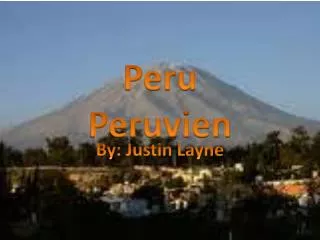
PeruPeruvien By: Justin Layne
Area- 512,000 square miles (1,326,074 square kilometers)
Capital City • Lima
Population • 29,659,885
Currency • Nuevo Sol • The Nuevo Sol is subdivided into 100 Centimos
Products ,Government, and Attractions • Rice, sugar cane, and cotton • Constitutional republic • Arequipa
History • In 1532 the Spanish soldier and adventurer Francisco Pizarro landed in Peru with a force of about 180 men. Conditions were likely to conquest, for the empire was destroyed by a present civil war between the heirs to the Inca throne, Atahualpa and Huascar, each of which were wanting to control the empire. This internal dissension, plus the terror inspired by Spanish guns and horses—unknown to the indigenous peoples until then—made it relatively easy for only a lot of Spaniards to conquer this large empire.
Works Cited • Images- http://www.google.com/ • Peru’s population- http://www.trueknowledge.com/q/population_of_peru_2011 • Currency- • http://www.limaeasy.com/money/peruvian_money.php • Products- http://www.chiclayo.com/ • Government- http://www.infoplease.com/ipa/A0107883.html • History- http://www.peru-explorer.com/history.htm