Download
1 / 8
80 likes | 226 Views
This guide explains the importance of significant figures in scientific calculations using the example of calculating the volume of a wooden block with specified dimensions. Although the numerical outcome may appear accurate (105.1687 cm³), it does not reflect the accuracy of the original measurements, emphasizing that significant figures determine the precision of numerical expressions. Learn to count significant figures by applying specific rules regarding nonzero digits, leading zeros, captive zeros, and trailing zeros, crucial for producing reliable scientific results.

E N D
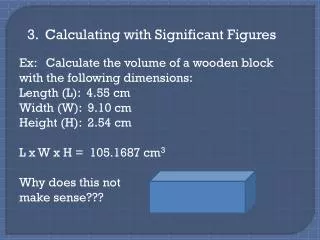
3. Calculating with Significant Figures Ex: Calculate the volume of a wooden block with the following dimensions: Length (L): 4.55 cm Width (W): 9.10 cm Height (H): 2.54 cm L x W x H = 105.1687 cm3 Why does this not make sense???
The answer claims to be more accurate than the original measurement accuracy.
Significant figures – the digits in a measurement that are expressed as its value. (“Sig Figs”) First we must know how to count significant figures in a given number.
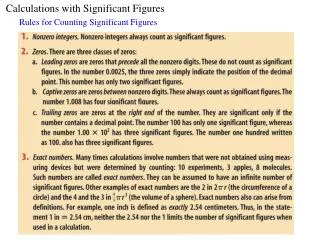
Rules for counting significant figures All nonzero digits are significant (ie, numbers 1 through 9 are ALWAYS significant) Ex: 14,567 5 SF Ex: 3245 4 SF
Zeros – there are three cases. Case 1: Leading Zeros Zeros that precede all non-zero digits NEVER count as significant figures. They are only placeholders Ex: 0.0025 2 SF (2 &5) Ex: 0.0005 1 SF (5)
Case 2: Captive zeros Any zeros that fall between nonzero digits ALWAYS count as significant figures. Ex: 1.008 4 SF Ex: 40, 005 5 SF
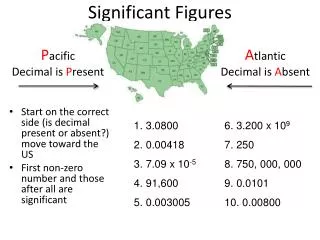
Case 3: Trailing zeros Zeros to the right end of the number are significant ONLY if the number contains a decimal point (yessy to Deci) Ex: 1200 2 SF Ex: 1200. 4 SF Ex: 1200.0 5 SF
Ex: 0.023 2 SF Ex: 0.0230 3 SF (2, 3 and trailing 0) Notice the decimal does not have to be near the trailing zero