Download
1 / 39
390 likes | 529 Views
This paper investigates spin waves in stripe-ordered systems, focusing on materials like nickelates, manganites, and cuprate superconductors. These systems exhibit strong correlations manifesting in unique k-space structures and minimized kinetic energy. We discuss the impact of real-space structures, including charge and spin density configurations. Techniques such as neutron scattering reveal critical phenomena, including the disappearance of peaks with doping and evidence of bond-ordered charge densities. The findings guide microscopic theories in superconductivity.

E N D
Spin Waves in Stripe Ordered Systems E. W. Carlson D. X. Yao D. K. Campbell
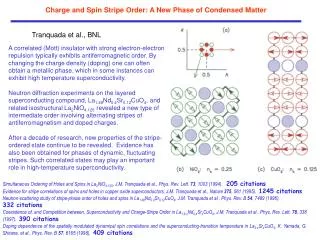
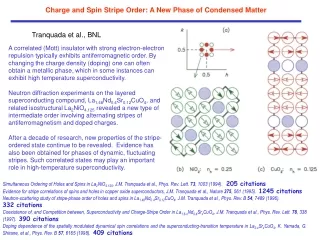
Strong Correlations • nickelates • manganites • cuprate superconductors • organic superconductors All show some evidence of real space order
Kinetic energy is minimized • k-space structure • Real space homogeneity • Interaction energy is important • Real space structure • spin • charge Strong Correlation Fermi Liquid
Organic Superconductors q -(ET)2 X (TMTST)2PF6 From S. Lefebvre et al., Physica B 312: 578-583 (2002) From E. Dagotto, cond-mat/0302550
Organic superconductors CDW, SDW Bond Order • BCSDW (Campbell) D. Chow et al., Phys Rev Lett 85 1698 (2000) (Mazumdar, Clay, and Campbell, Synth. Met. 137, 1317 (2003)
Cu-O or Ni-O Planes Other Layers Layered structure quasi-2D system Cuprates and Nickelates Layered structure quasi-2D system
Cuprates and Nickelates Dope with holes (remove spins) Topological Doping Ni: S=1 Cu: S=1/2 Oxygen Cu or Ni
Cuprates Dope with holes Superconducts at certain dopings T SC AF x Oxygen Cu or Ni
δ=0 δ=0 π π π Neutron Scattering in Cuprates and Nickelates Disappearance of (π,π) peak with doping Appearance of satellite peaks AFM signal averages to zero antiphase domain walls π
Issues: nature – static vs. dynamic orientation – vertical vs. diagonal spacing – commensuratevs. incommensurate width – one atom vs. two ... location of holes – site-centered vs. bond-centered
Cuprates stripes: interleaved charge and spin density (Kivelson, Emery) (Zaanen) (Castro Neto, Morais-Smith) bond-ordered charge density (Sachdev) from Almason and Maple (1991) 2D magnetic/current textures: DDW (Marsten, Chakravarty, Morr); Staggered flux (Lee); Loops (Varma)
Scattering Probes Energy, Momentum Phase Information? Yes in certain cases Goals: • Phase-sensitive information from diffraction probe • Guidance for microscopic theories of superconductivity in cuprates, organics
Ja Ja Jb Jb Bond-centered p=3 π Both produce weight at (π+ π/p, π) π Site or Bond-Centered Site-centered p=3 Ja > 0 (AFM) Jb> 0 (AFM) • Ja > 0 (AFM) Jb< 0 (FM)
Ja Jb • Bond-centered, p=3 • Ja > 0 (AFM) Jb< 0 (FM) Model and Method Heisenberg model
π π Spacing p=3 Magnetic Reciprocal Lattice Vectors Site-centered p=3 Bond-centered p=3
π π Spacing p=4 Magnetic Reciprocal Lattice Vectors Site-centered p=4 Bond-centered p=4
Elastic Neutron Scattering f(n) g(m)
f(n) g(m) π π Elastic Neutron Scattering p=3 Site-centered
f(n) g(m) Elastic Neutron Scattering p=3 Site-centered π π
π π Elastic Neutron Scattering p=3 Bond-centered f(n) g(m)
Elastic Neutron Scattering p=3 Bond-centered f(n) g(m) π π
Bond-centered p=3 f(n) f(n) g(m) g(m) π π π π Site vs. Bond-Centered p=3 Site-centered p=3
π π π π Site vs. Bond-Centered p=4 Site-centered p=4 f(n) g(m) Bond-centered p=4 f(n) g(m)
Elastic Peaks 2D Antiphase Domain Walls Site-centered: never weight at Bond-centered: no weight at for p=EVEN generic weight at for p=ODD The presence of weight at with incommensurate peaks at is positive evidence of a bond-centered configuration
Ja Jb • Bond-centered, p=3 • Ja > 0 (AFM) Jb< 0 (FM) Model and Method Heisenberg model
Model and Method Heisenberg model Holstein-Primakoff Bosons Up Spins: Down Spins:
Fourier transformation + symplectic transformation yield spectrum and eigenstates Model and Method Heisenberg model
Number of Bands Site-centered p=4 p-1 spins per unit cell Spin up/Spin down degeneracy ) (p-1)/2 bands 3 bands for p=4 Bond-centered p=4 p spins per unit cell Spin up/Spin down degeneracy ) p/2 bands 4 bands for p=4
π π Site-Centered: S(k,w) Jb=0.4 Ja Jb=1.0 Ja Jb=2.5 Ja p=3 p=4 kx N.B. Site-centered consistent with F.Kruger and S. Scheidl, PRB 67, 134512 (2003)
π π Bond-Centered: S(k, w) Jb= - 0.1 Ja Jb=-0.56 Ja Jb=-1.0 Ja p=2 • Note the elastic weight for p=3 p=3 p=4 kx
S3 k=(π, π) Energy dependence on λ= k=(0,0) S4
Energy dependence on λ= B2 k=(π, π) k=(0,0) B3 B4
|| AF Site-centered velocities v velocity along the stripe direction v velocity perpendicular to the stripe direction v velocity of pure 2D antiferromagnet
Bond-centered velocities || AF v velocity along the stripe direction v velocity perpendicular to the stripe direction v velocity of pure 2D antiferromagnet
Conclusions Elastic: For both 2D and 3D antiphase domain walls, bond-centered p=ODD stripes show new peaks, forbidden for site-centered Inelastic: • Number of bands distinguishes site- or bond-centered Site: (p-1) bands Bond: (p) bands • Qualitatively different spin wave spectra Site: all bands increase with J_b Bond: lower bands independent of J_b top band ~ 2 J_b • Velocity anisotropy Bond-centered is rather isotropic over a large range of parameters Extensions: • Diagonal spin waves • Other spin textures