Download
1 / 30
310 likes | 452 Views
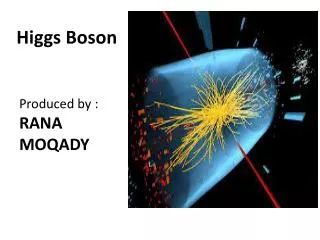
The Higgs boson is integral to our understanding of particle physics. We explore why they are crucial, what they look like, and the evidence for their existence. Quantum Electrodynamics predicts massless gauge bosons (photons), while Quantum Chromodynamics predicts gluons. In contrast, W and Z bosons are massive with crucial roles in symmetry breaking and mass generation through the Higgs field. We delve into their detection methods at CERN, including the creation and decay processes, and the mysteries surrounding their properties.

E N D
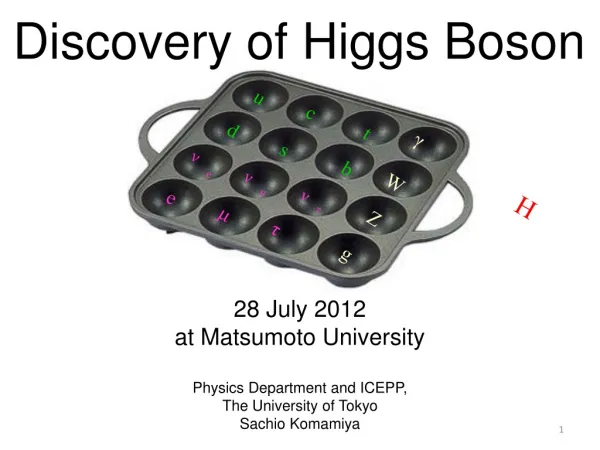
Higgs boson(s) • Why do we need them? • What do they look like? • Have we found them?
γ Quantum Electrodynamicspredicts one masslessspin-1gauge boson PHOTON
g Quantum Chromodynamicspredicts (32-1) = 8 masslessspin-1gauge bosons g g g g g g g GLUONS
Quantum Flavour Dynamicspredicts (22-1) = 3 masslessspin-1 gauge bosons ? Z W
W and Z boson are NOT massless Mass of W bosons… 80 GeV Mass of Z bosons … 91 GeV Weigh more than a copper atom
Massivespin-1 particles have 3 polarisations • Helicity= +1 or 0 or -1
Massless spin-1 particles have only 2 polarisations • Horizontal or vertical polarised photons • Helicity = +1 or -1 only • Longitudinal polarisation is lost! W and Z bosons need extra degree of polarisation as massive
Giving mass to the W and Z New field H W or Z W or Z W and Z bosons pick up mass from interaction with new scalar field Pops out of vacuum & modifies propagator
“Higgs” field • Field must have non-zero vacuum value everywhere • Universe filled with “relativistic ether” of this field • Coupling to the field gives mass to W and Z
Symmetry breaking & the Higgs field • Require: underlying theory is symmetric • Vacuum or ground state has broken symmetry
Magnetic material at high temperatures Symmetric in direction
Magnetic material at low temperature Symmetry broken – special direction
Standard Model has complex doublet • 4 degrees of freedom • 3 end up as longitudinal polarisations of W and Z bosons • 1 left over – excitation of the field – Higgs Boson
In the Standard Model the SAME Higgs field • gives mass to the: • W boson • Z boson • all the quarks and leptons
Higgs couplings to mass H H V V f f
Higgs boson production and decay Blackboard
P Reconstructing the debris
Detectors… • Robotic assembly of precision silicon tracker – Denys Wilkinson Building
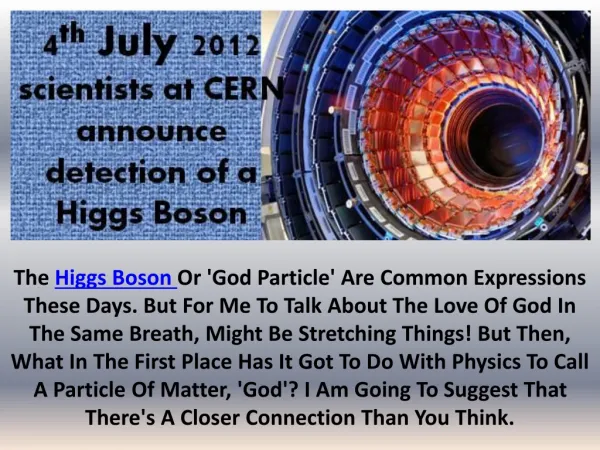
ATLAS Segment of detector
A collision producing 2 high-energy photons Higgs + ?
Higgs 2 photons Bump at mass of new particle
Many questions unanswered… Does it couple to itself? What shape is the potential Are there more Higgs bosons? Why is the mass of the Higgs boson not HUGE?