Evolutionary Pathways of Massive Stars: Insights into Red Supergiants and Potential Outcomes
70 likes | 182 Views
This paper explores the evolution of massive stars, focusing on the roles of rotation and convective cores in their development into red supergiants. We examine the potential outcomes, including supernovae (SN II), gamma-ray bursts (GRBs), and the formation of black holes, contingent upon the stars' mass and composition. Emphasis is placed on the CNO and Ne-Na cycles and the significance of various studies, including observations and theoretical frameworks presented at recent conferences, highlighting the interplay of stellar processes during the main sequence and beyond.


Evolutionary Pathways of Massive Stars: Insights into Red Supergiants and Potential Outcomes
E N D
Presentation Transcript
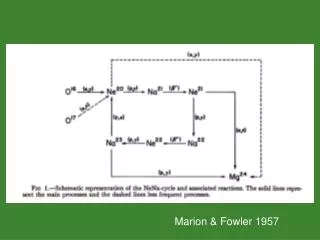
NO ROTATION Main Sequence Convective Core Pre SN II Red Supergiant H H conv H etc He H->He C O H->He He Si Ne ROTATION Evolving Main Sequence Maybe SN II Maybe GRB Maybe Black Hole CNO Ne Na Cycle H->He CNO
Bibliography Ne Na Cycle: Izzard et al. 2007 A&A 466, 641 Poster Paper by Wallerstein et al. at Caltech Conference 2007 Rotating Massive Stars: Decressin et al. 2007 A&A 464, 1029 AGB Stars: Pumo, D’Antona & Ventura (not Jesse) 2008 ApJ 672, L25 Observations: Gratton, Sneden & Carretta ARA&A 2004 42, 385