IONIC AND COVALENT STRUCTURES
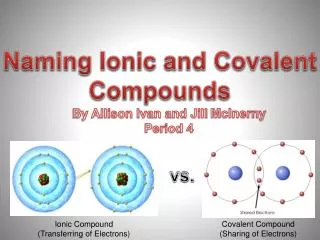
This notebook dives deep into the fundamentals of ionic and covalent structures in chemistry. It explores how ionic bonds form between metals and non-metals through the transfer of electrons, emphasizing the octet rule and the significance of valence electrons. You'll learn to balance compounds, identify cations and anions, and construct Lewis dot structures for covalent compounds. Key concepts such as shared and lone pair electrons are explained, providing a comprehensive look at atomic interactions and bonding. Master these essential building blocks of chemistry!

IONIC AND COVALENT STRUCTURES
E N D
Presentation Transcript
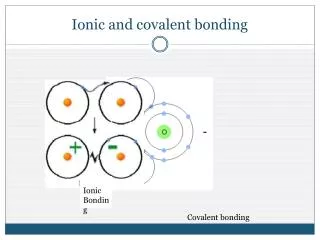
IONIC AND COVALENT STRUCTURES IONIC = metal + non metal COVALENT = non metal + non metal
Ionic Background • Octet Rule • Atoms try to fulfill their Octet by either GAINING or LOSING electrons from their VALENCE shell • Groups 1 – 4 • LOSE • Groups 5 – 7 • GAIN
Ionic Background • Charges • Dependent on Valence Electrons • Octet Rule • + = electrons LOST • - = electrons GAINED • F = ? • Na = ? • N = ? • Li = ?
IONIC FLOW BALANCE DOTS FINAL PRODUCT DONATE & RECEIVE
BALANCE • Balance the elements in your compound • Determine your charges • Balance them (equal amounts of + and - ) • The compound must show a Neutral formula! • Mg & Cl • Mg 2+Cl1- • Mg 2+Cl1- • Bring the number down NOT the charge • MgCl2 • Our balanced formula has ONE magnesium and TWO chlorines
DOTS • Draw ALL the dot structures for your Balanced compound • REMEMBER • Dot structures only represent the VALENCE electrons • Look at the element’s GROUP number for its VALENCE number • MgCl2 • We have one magnesium and two chlorines • So we need…
DONATE AND RECEIVE • CATIONS • Are the metal elements that DONATE their electrons (+) • ANIONS • Are the non metal elements that RECEIVE their electrons (-) • Label cation/anions and show where the electrons are going
FINAL PRODUCT • The final product shows the elements AFTER the electrons have been DONATED & RECEIVED • Charges are shown • Elements in Brackets
Covalent Background • LEWIS DOT STRUCTURES • BONDS (shared electrons) • Shown by lines between elements • 1 bonds = 2 shared e- • 2 bonds = 4 shared e- • 3 bonds = 6 shared e- • LONE PAIRS • Pairs of non bonding electrons
NASL NUMBER of full valence electrons AVAILABLE valence electrons LONE pairs SHARED electrons
Number of FULL valence electrons • If all the valence shells involved were full… • For example… • NH3 • Nitrogen full octet = 8 • Hydrogen full octet = 2 • Hydrogen full octet = 2 • Hydrogen full octet = 2 • 14 electrons
Available valence electrons • How many valence electrons are actually available on the elements??? • NH3 • Nitrogen = 5 • Hydrogen = 1 • Hydrogen = 1 • Hydrogen = 1 • 8 electrons
SHARED electrons (bonds) • Every 2 electrons is ONE bond • SHARED = N – A • NH3 • N – A • 14 – 8 • 6 SHARED e- • 3 bonds
LONE pairs • Every 2 electrons that are NOT involved in bonding • LONE pairs = A – S • NH3 • A – S • 8 – 6 • 2 LONE pair electrons
NH3 Lewis Dot Structures SHARED -> 3 bonds LONE PAIRS -> 2 electrons
FULL OCTETS?? Nitrogen -> 3 bonds -> 1 lone pair Hydrogen (3) -> 1 bond 1 bond = 2 electrons 1 lone pair = 2 electrons SHARED/BONDED electrons fulfill the Octet