Download
1 / 7
70 likes | 197 Views
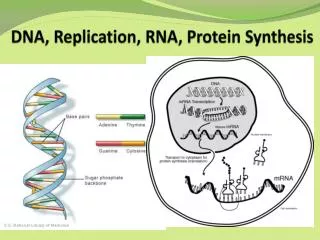
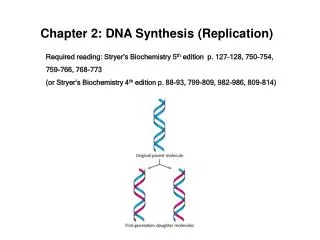
This overview explores the intricate process of DNA replication, emphasizing the significance of complementarity in base pairing and its implications for copying mechanisms. Key modes of DNA replication—conservative, semiconservative, and dispersive—are discussed, along with the critical roles of DNA polymerases. The process is directional, occurring in a 5’-to-3’ manner, and the exonuclease activities of DNA polymerases ensure fidelity in DNA synthesis. Understanding these concepts is essential for grasping molecular biology and genetics.

E N D
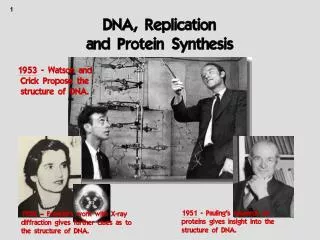
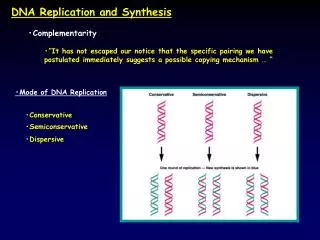
DNA Replication and Synthesis •Complementarity •”It has not escaped our notice that the specific pairing we have postulated immediately suggests a possible copying mechanism … “ •Mode of DNA Replication •Conservative •Semiconservative •Dispersive
Origin and Direction Replication fork Replicon
DNA Polymerases •chain elongation in a 5’-to-3’ direction •biological activity?