Understanding Fundamental Quantities in Physics: Charge and Electric Force
This exposition explores fundamental quantities critical to understanding physics, emphasizing mass, time, length, and the significant addition of charge. Introduced by Michael Faraday, charge is identified through electrons, embodying both positive and negative varieties that interact through attractive and repulsive forces. We delve into Coulomb's Law, which quantifies the electric force between charges, and demonstrate practical applications through experiments involving electrostatic forces, such as using a Van de Graaff generator and an electroscope. Gain insight into how these concepts govern interactions within the atomic realm.

Understanding Fundamental Quantities in Physics: Charge and Electric Force
E N D
Presentation Transcript
Electric Force IDS Physics: M Blachly
Fundamental Quantities • There are a few quantities that are fundamental to our universe. We cannot define them in terms of anything else: they just are. • Examples • Mass • Time • Length • Velocity is not fundamental, because it can be defined in terms of length and time.
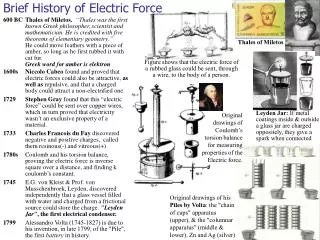
Fundamental Quantities • We now reach a new fundamental quantity: Charge • Discovered by Michael Faraday in 1833 when he proposed that current must be the flow of discrete entities. • The electron is what we now identify as the carrier of a charge. The word comes from the Greek elektron, which means “Amber”. The Greeks discovered that amber rubbed with fur attracted light objects such as feathers.
Charge • There are two types of charge: positive and negative. • When these charges occur in equal ratios, there is no net charge. • Opposite charges attract, like charges repel.
Bohr Model of the Atom • The negative charge orbits around the positive charge. • This is a model: it is not how it actually is, but just a way to think about some of the important concepts
Exploring Charge • We can explore charge using a Van der Graff generator, which removes electrons from the dome.
Things to explore • Pith balls, charged balloons and charged hair
More things to Explore • The Electroscope • Used to detect the presence of charge. • The leaves fly apart if the ball touches anything that contains excess positive or negative charge. • Charged balloons and streams of water.
Measuring Charge • Coulombs became the standard unit of charge before we knew what the source of charge actually was. • 1 electron has a charge of 1.6 x 10⁻¹⁹ C • How many electrons does it take to make 1 Coulomb of charge?
Electric Force • It was known that there was a force between positive and negative charges • Charles-Augustin de Coulomb quantified this relationship
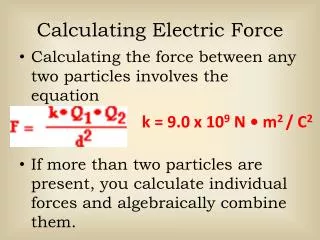
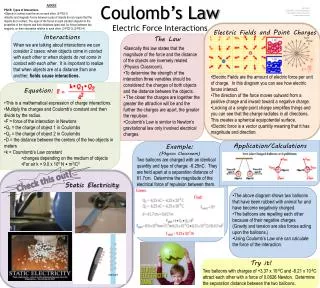
Coulombs Law • Coulombs Law tells us the magnitude of the force between any two charges.
Example Calculation • Two balloons each have a charge of 300 nC and they are 30 cm apart. What is the force of repulsion between them?
Another Example • Consider two charges, one of 3.0 µC at x=5 meter and the other of -5.0 µC at x=1 m. What is the magnitude and direction of the electrostatic force on the 3.0 µC charge?
Superposition Principle • The total force on any charge is the sum of the forces from each of the other charges.
Example • Find the force on the 2 nC charge due to the other charges.