Download
1 / 17
170 likes | 318 Views
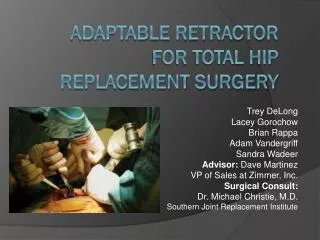
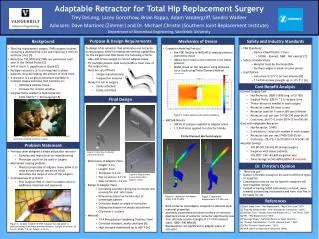
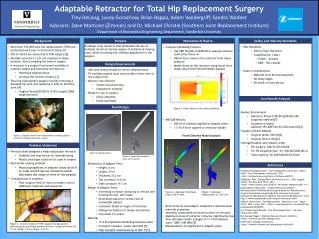
The current narrow tissue retractors in total hip replacement surgeries pose challenges, especially for obese patients, leading to increased surgery time and costs. Our engineering team presents an adaptable retractor design that is robust, simple, and effective for various patient sizes. This device reduces the need for multiple retractors, enhances the surgical field visibility, and facilitates a more efficient operation. With goals set on cost-effective production and easy sterilization, this innovative retractor aims to improve surgical experiences while addressing the pressing issue of rising obesity rates among adults.

E N D
Trey DeLong Lacey Gorochow Brian Rappa Adam Vandergriff Sandra Wadeer Advisor: Dave Martinez VP of Sales at Zimmer, Inc. Adaptable Retractor for Total Hip Replacement Surgery
Problem Statement • Current tissue retractors are narrow, multiple retractors are required especially in obese patients • NY times reports 34% adults are obese • +Surgical Techs($20.00/hr*2-4hr/surgery*200k surgeries/year) • Time of surgery increases as well • Previous team designed an adjustable retractor • Complex and impractical for industrial production • Prototype could not be used in surgery
Mechanism & Consequences • Mechanism causing the problem Physical properties of adipose tissue allow it to wrap around narrow retractors • Consequences of unresolved problem Poor surgical field of vision Increase cost for additional materials and personnel
Surgery Experience 4-5 in (6 in in bigger patient) 3 in wide Fat tissue getting in the way
Dr. Christie’s Perspective • Functions of retractor: • Pull on incision • Keep tissue from falling into surgical window • Disposability • Not “green” • Ideal Device: • Robust • Simple • Movable window
Design Requirements & Objectives • Keep back adipose tissue • Fit multiple patient sizes and provide a clear view of the surgical site • Must be cost efficient • Simple manufacturing • cheap material • Ready for use in surgery • Easily attached • Easily sterilized • Strong enough to hold back fat tissue
Preliminary Design • Similar to cheek retractor • Plastic material • Disposable • Hands-free • Does not allow for mobile window • No relaxation on one side (non-movable window)
Preliminary Design #1 Flap(similar to cheek retractor) 4 in Guide Rails 1 in sliding room
Preliminary Design #2 3 guide rails inside this part
Preliminary Design #3 Rails Guides Attaching Part Retractor
Goals • Reduce total hip replacement surgery cost • Less personnel in the operating room • Less retractors needed for surgery • Increase vision and work room for the surgeon • Increase efficiency of the surgery • Reduce surgery time
Performance Metrics • Retractor system work on 95% of patients • Different size attachments for non-disposable and disposable design • Costs • Keep production costs minimal • Mass production • Readily machined • Predicted to be ~$300 for retractor and attachments (non-disposable) • Disposable: $1-$10 per device
System and Environment • Role in surgery • Increase view of region and allows access • Why its beneficial to the surgeon • Reduce people near patient • Reduce number of retractors • Make surgery easier
Testing Methods • Verification • Ensuring all parts of the device function together properly • Detect errors at all stages of development • Validation • Determine whether device is easily sterilized • Hardware Testing • Use of mechanical equipment to test strength of device • Stress Testing • Pro/E Mechanical Analysis • Safety Testing • Take into surgery and access ability to use device
References • http://www.bls.gov/bls/blswage.htm • http://www.innomed.net/hip_rets_mis.htm#Anchor-APC-49575 • http://www.nytimes.com/2010/01/14/health/14obese.html • http://www.orthosupersite.com/view.aspx?rid=1889 • http://www.zimmer.com/z/ctl/op/global/action/1/id/8140/template/PC/navid/10427