Interference, Beats and the Doppler Effect
170 likes | 322 Views
Lecture 9. Interference, Beats and the Doppler Effect. Pre-reading : §16.6–16.7. Wave Interference. Two or more traveling waves passing through same space at same time (identical frequencies) Use principle of superposition Consider the difference in path length to the sources


Interference, Beats and the Doppler Effect
E N D
Presentation Transcript
Lecture 9 Interference, Beatsand theDoppler Effect Pre-reading: §16.6–16.7
Wave Interference • Two or more traveling waves passing through same space at same time (identical frequencies) • Use principle of superposition • Consider the difference in path length to the sources • Constructive interference (double amplitude): • path length difference is 0, λ, 2λ, 3λ, ... • Destructive interference (zero amplitude): • path length difference is λ/2, 3λ/2, 5λ/2, ...
Example 16.13 • Speakers A and B emit identical sinusoids • Speed of sound is 350 m/s • What is frequency of waves if there is • constructive interference at P ? • destructive interference at P ?
Interference in light (non-examinable) • Radio astronomy: interferometers Very Large ArrayNew Mexico, USA Australia Telescope Compact Array, Narrabri, NSW
Precision distance measurement: Gravitational wave detectors The 2-km arms of the LIGO detector in Washington State http://apod.nasa.gov/apod/ap001030.html
Beats • Two (or more) traveling waves passing through same space at same time (different frequencies) • You hear both frequencies (fa and fb) • ALSO hear amplitude grow and fall at the beat frequency fbeat = |fa – fb| §16.7
Example • One tuning fork vibrates at 440 Hz • A second tuning fork vibrates with unknown frequency • With both forks sounded, you hear a tone with an amplitude that changes with frequency of 3 Hz • What is the frequency of the second tuning fork?
Example: Strobe lighting – slowing down a motion Video of a fruit fly using a wing beat synchronised strobe flash with incrementing phase shift. The motion is slowed down by a factor of 1:256(The fruit fly beats its wings 200 times a second) https://www.youtube.com/watch?v=Q5rhLHfwpUk
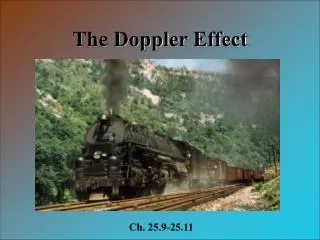
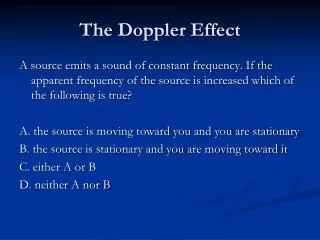
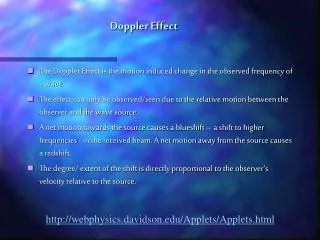
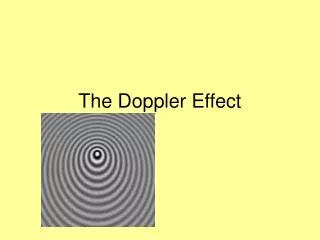
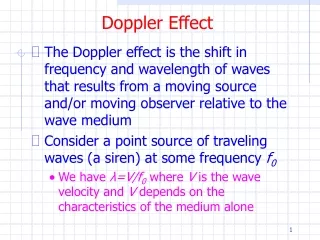
Doppler Effect • Change in perceived frequency due to relative motion of a source (S) and listener (L) Stationary Source Moving Source
Doppler Effect • Change in perceived frequency due to relative motion of a source (S) and listener (L) • Case 1: Source at rest, Listener movingfL = (1 + vL/v) × fS • Case 2: Source and Listener moving • Pay attention to sign of vL, vS ! (positive from L to S) • For light wavesfL = √[ (c–v) / (c+v) ] × fS c = 3.0 × 10⁸ ms–1
Doppler Effect • Change in perceived frequency due to relative motion of a source (S) and listener (L) • Case 1: Source at rest, Listener movingfL = (1 + vL/v) × fS • Case 2: Source and Listener moving • Pay attention to sign of vL, vS ! (positive from L to S) • For light wavesfL = √[ (c–v) / (c+v) ] × fS c = 3.0 × 10⁸ ms–1
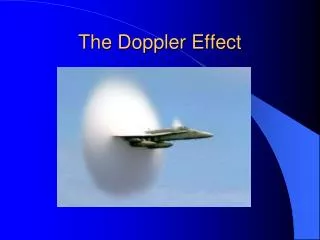
Next lecture • Doppler effect • and • Shock waves • Read §16.8–16.9