Understanding Ecosystems: Producers, Consumers, and Food Web Dynamics
This text explores the fundamental concepts of ecosystems, including the roles of various living organisms. It defines producers as organisms capable of making their own food, while consumers are reliant on consuming other living things. The distinctions between herbivores, carnivores, and omnivores are clarified, alongside the important roles of decomposers in the nutrient cycle. It discusses habitats, niches, and the relationships between predators and their prey. Finally, it highlights food webs and energy pyramids that illustrate energy transfer in ecological networks.

Understanding Ecosystems: Producers, Consumers, and Food Web Dynamics
E N D
Presentation Transcript
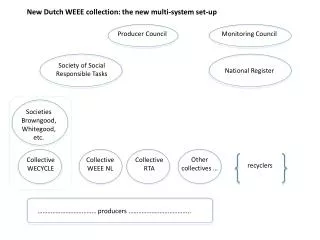
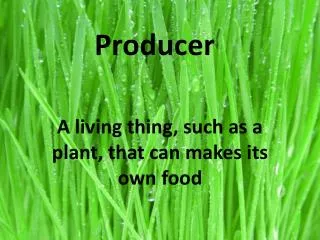
Producer A living thing, such as a plant, that can makes its own food
Consumer A living thing that can’t make its own food and must eat other living things.
Herbivore An animal that eats only plants or producers.
Carnivore An animal that eats only other animals.
Omnivore An animal that eats both plants and other animals
Decomposer A living thing that feeds on the wastes and remains of plants and animals
Habitat An environment that meets the needs of an organism
Niche The role of an organism in its habitat
Prey Consumers that are eaten by predators
Predators A consumer that eats prey
Food Web A group of food chains that overlap
Energy Pyramid A diagram showing how much energy is passed form one organism to the next in a food chain